Category: Reflections

Thoughts and observations that step back from the day-to-day to explore ideas within my creative life.

  • Drawing Through a Transition and a New Understanding

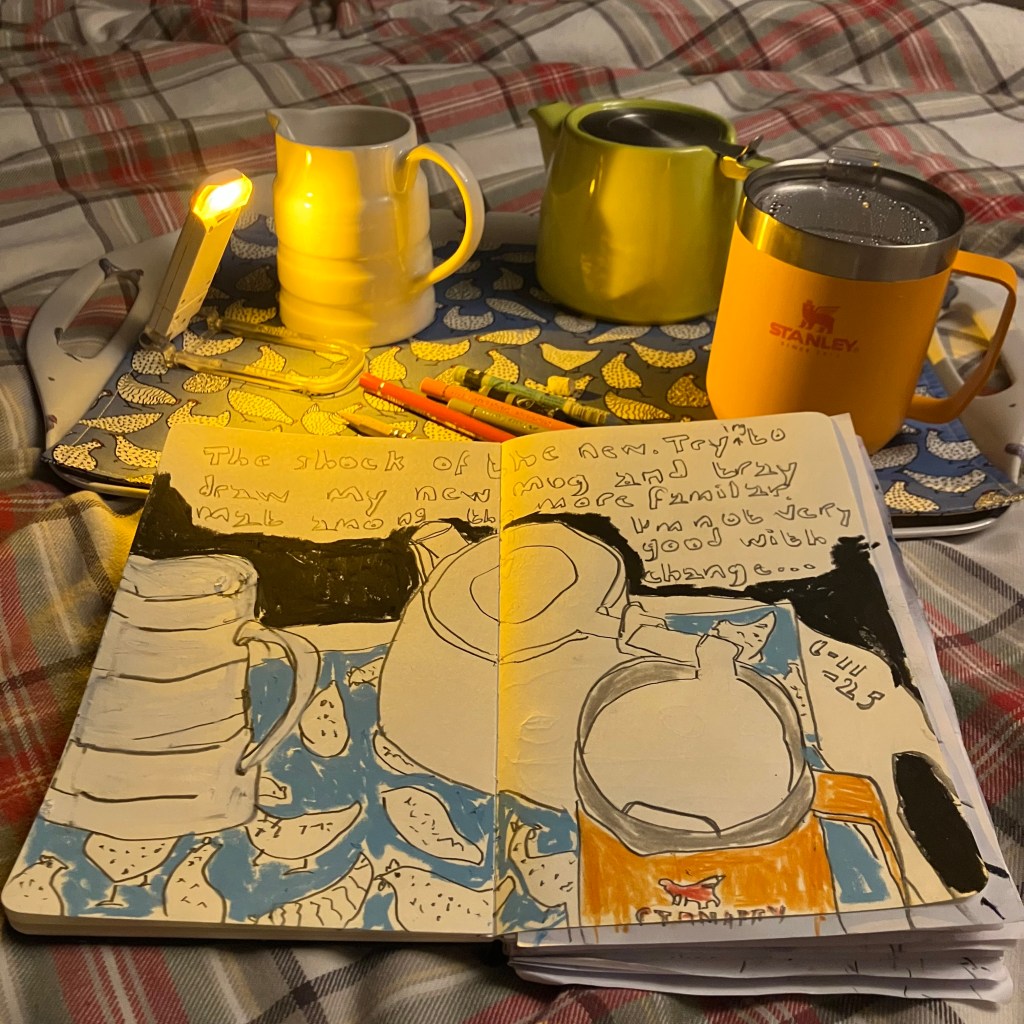
    An open sketchbook lies on a bed beside a tray. On the tray are a white ridged jug, a small green teapot, and a bright orange insulated mug on a chicken-patterned mat. The drawing in the sketchbook depicts these same objects and their arrangement. Coloured pencils and a small reading light are nearby. The scene is softly lit with warm, indirect light.

    Two new things in my world

    When something changes in my small daily world, it can feel larger than it might seem to someone else. I often need time to learn how to be alongside the new thing — to find its place and let it find mine. Drawing can help with this — not always straight away or with one drawing, but over time, drawing by drawing, I can begin to feel comfortable with the new and unfamiliar.

    Today’s drawing, The Shock of the New shows the start of a transition. I have a new bright orange mug and a new turquoise tray mat covered with small white chickens. I really love them both, but on my tray, in this drawing, they both felt out of place — loud, jarring and too new.

    Drawing through the discomfort of transition

    In the drawing, the new mug appears only partly on the page, as though it hasn’t quite entered the familiar world of the drawing yet. The chickens on the tray are clumsy — my hand doesn’t know their shapes, so it feels its way slowly, uncertainly. Nothing is fully settled. I am still working out how these new things belong.

    As I stayed with the drawing, I noticed that something began to shift a little. The new objects didn’t feel comfortable, exactly — but they felt less abrupt. I wasn’t trying to make them fit, but I was enjoying exploring them and and feeling the possibility that they might.

    What I’m beginning to understand

    I’m beginning to see that drawing helps me move slowly through a change, to sit with the discomfort of it, and to let something unfamiliar become part of my world. In that sense, it is a therapeutic process.

    More than that, I’ve realised today (with a quiet shock of recognition) that my recent drawings have also been revealing a little more about me than I had quite seen before. I think that understanding is part of another transition and I need to let it arrive slowly too — drawing by drawing.
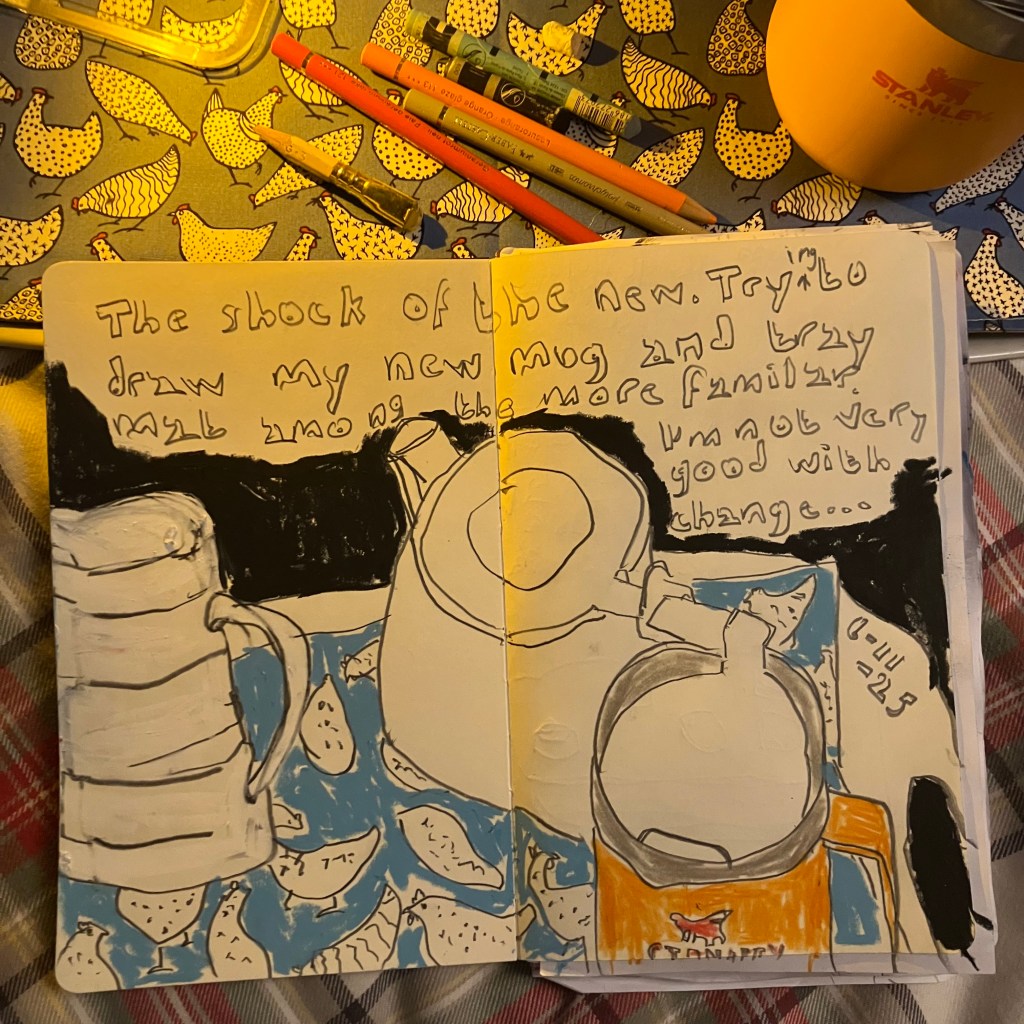
    A close view of an open sketchbook page showing a line drawing of objects on a tea-tray: a ridged jug, a small teapot, and the upper portion of a tall insulated mug. The tray mat beneath them is turquoise and patterned with small repeated white chickens. Areas of flat colour appear in turquoise, black, and orange. At the top of the page, handwritten text reads: “The shock of the new. Trying to draw my new mug and tray mat among the more familar (sic). I'm not very good with change.” The image is lit by a soft orange light, which may be somewhat altering the appearance of the colours.
    The Shock of the New (6th October 2025)

  • Drawing through unease

    The drawings that trouble me

    Lately, I’ve been thinking about the drawings that make me uncomfortable, embarrass me — the ones I’d like to rip out of my sketchbook and forget.

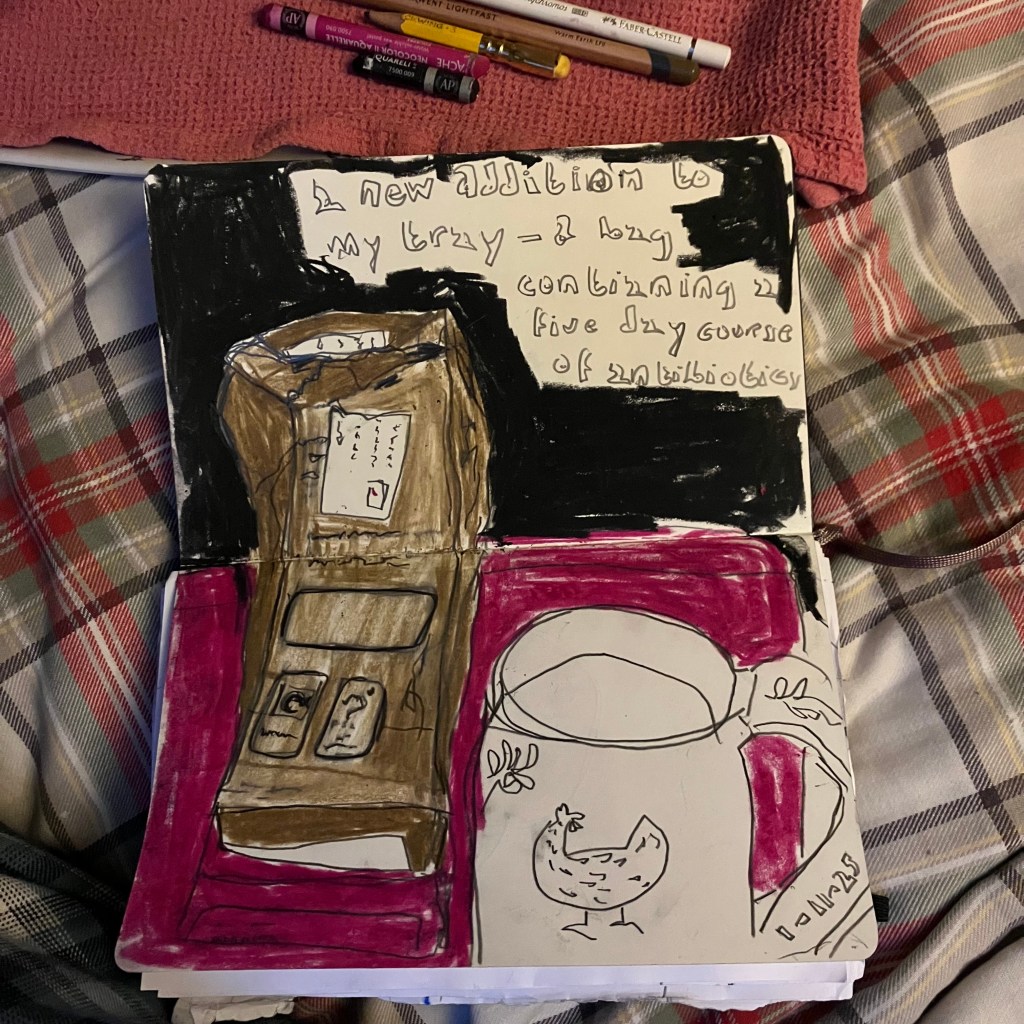
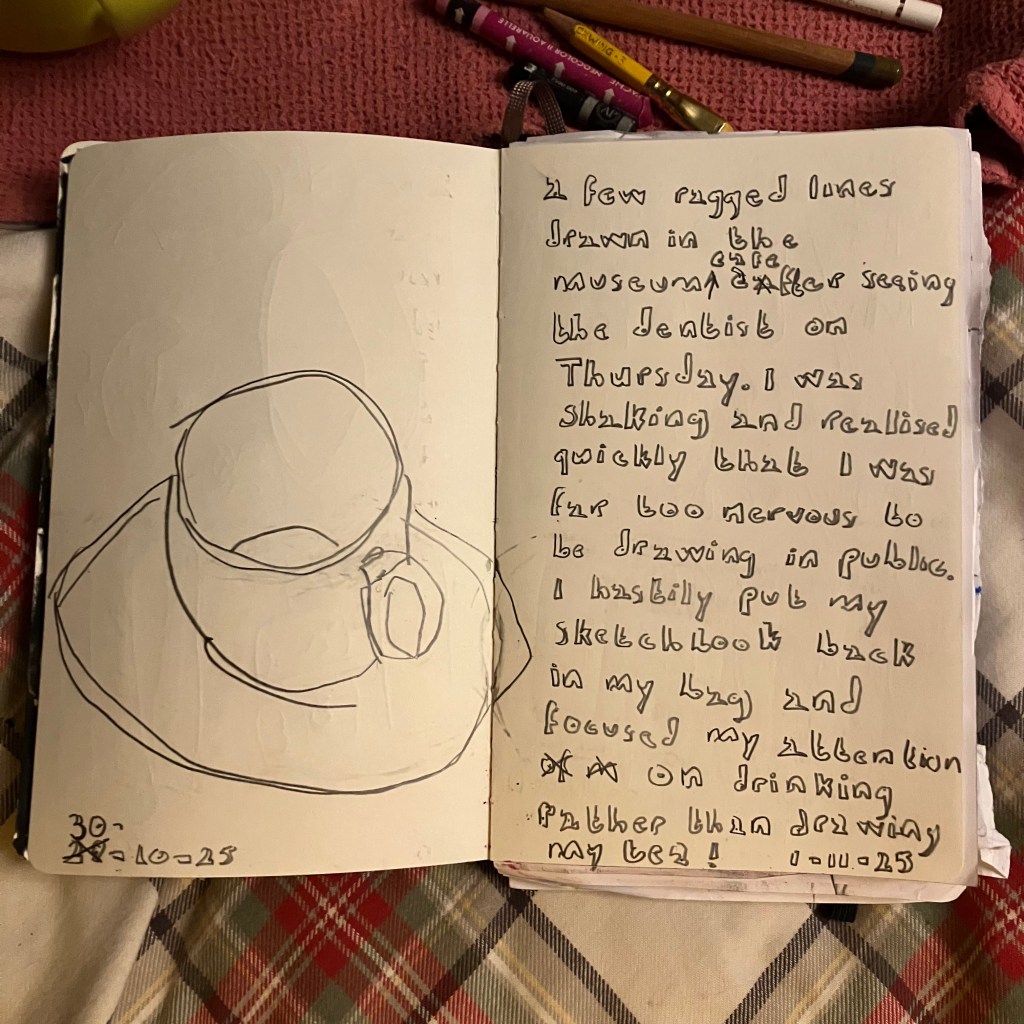
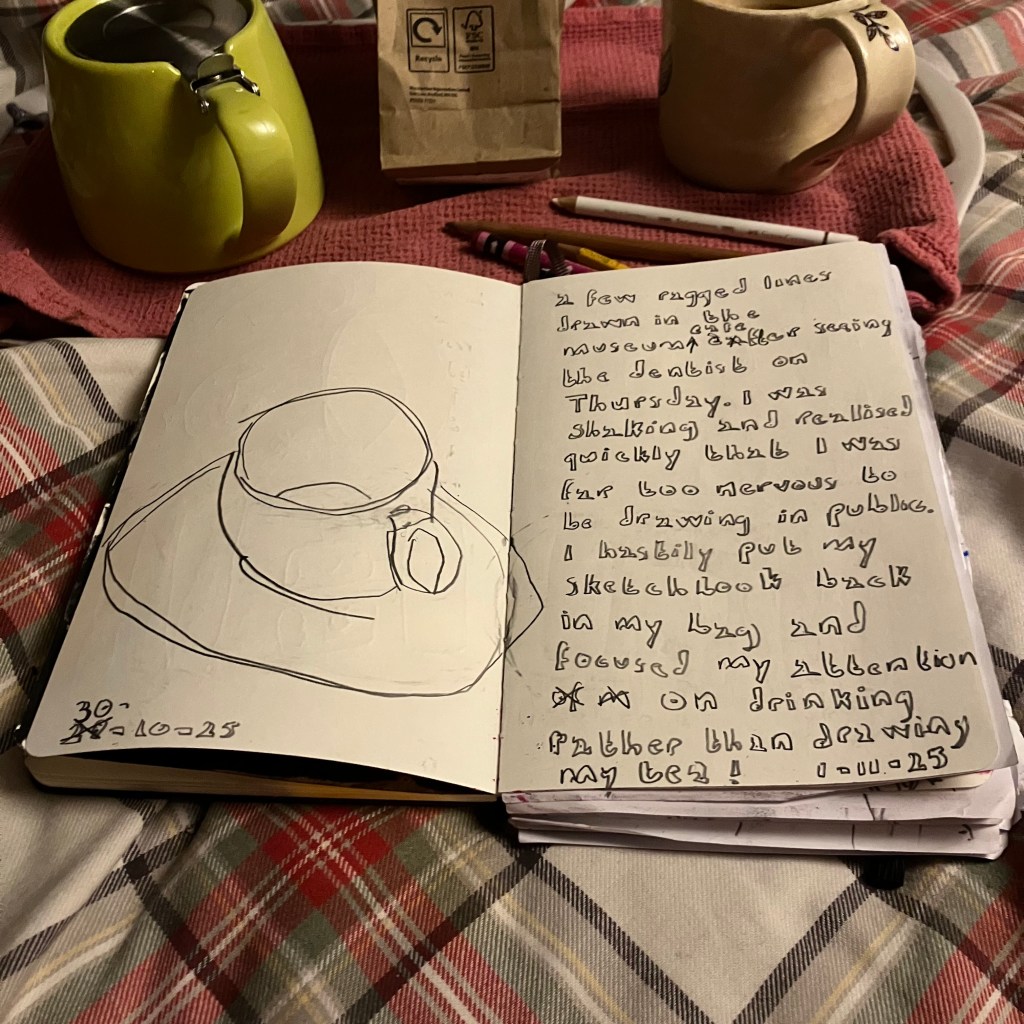
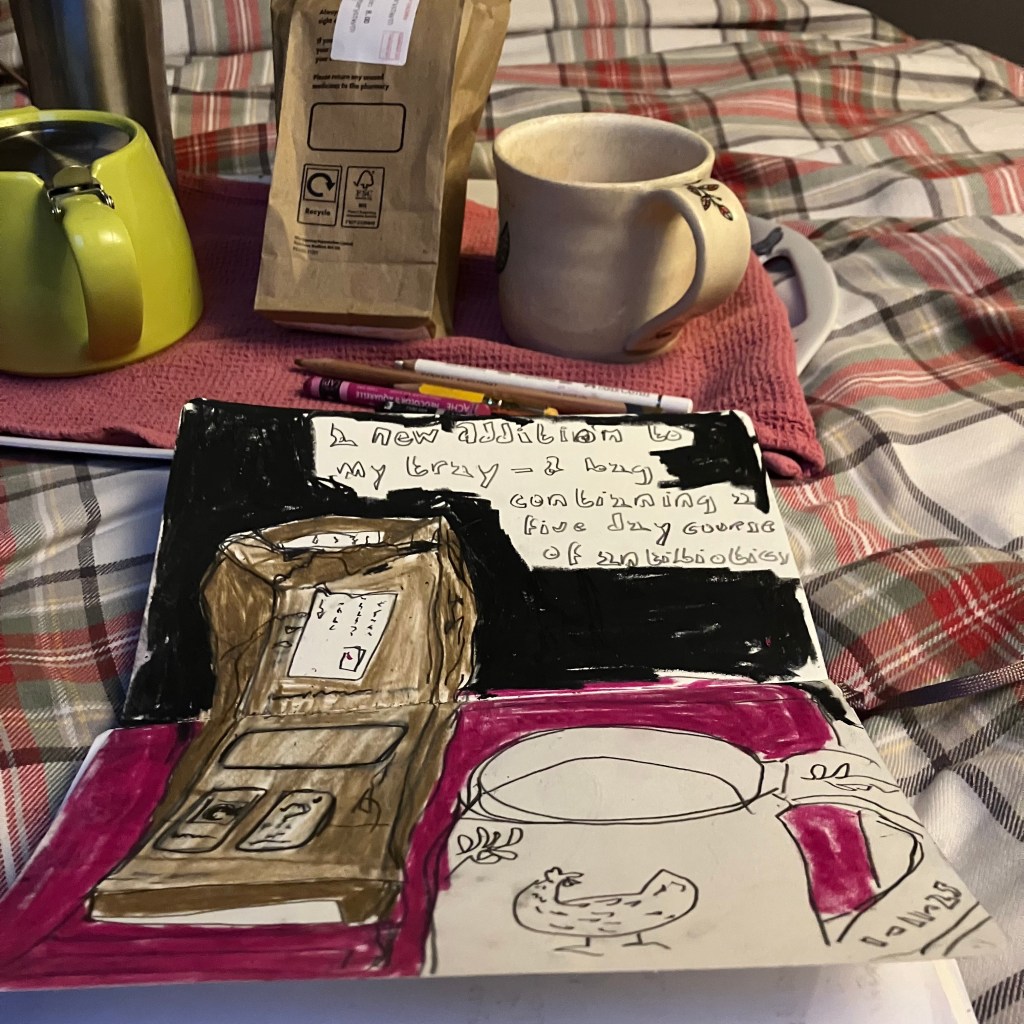
    This week there have been two of them (so far!): A Few Ragged Lines, drawn in the museum café just after my dental appointment, and A New Addition to My Tray, made from bed this morning.

    In the café, I managed only a few hesitant marks before realising how shaky I was. The drawing stopped almost as soon as it began. Today, a few days later, I added the text and then began A New Addition to My Tray — my first attempt at drawing since that trip to the dentist. I realised quickly that I was still dealing with anxiety. The text on A Few Ragged Lines is ragged and uncertain — I corrected myself more than once — and in A New Addition to My Tray I kept reworking the small brown pharmacy bag. The more I drew, the more uneasy I felt.

    On embarrassment and honesty

    There’s a particular kind of embarrassment that comes with this — when a drawing feels raw, clumsy, too revealing. Some of that embarrassment is about what the drawing might expose, but more immediately it’s about how it looks: awkward, unresolved, unskilled. It’s the discomfort of seeing something I’ve made that doesn’t live up to how I wanted it to be. For a while I often can’t bear to open my sketchbook and look at what I’ve made.

    After a few days (sometimes hours), those feelings can shift. With A Few Ragged Lines, that has happened — I have begun to see the original lines that I made on Thursday, not as failures, but as traces of persistence, an honest snapshot of a difficult moment in my life. The trembling, the awkwardness, the unresolved forms: they all speak of the effort to keep going, even when calm attention won’t quite come. Maybe, in time, I’ll be able to see today’s drawing in a similar light…

    Preserving the work as it is

    Part of my practice now is to preserve and reveal my sketchbooks exactly as they are. Once I add the date to a drawing, it’s finished — a small record of that moment, however incomplete or uneasy it feels. I want to resist the temptation to tidy, edit, or hide these pages. I want them to remain a true reflection of the moment that they were made, however that feels and whatever they reveal.

    I’ve been thinking about whether adding text to A Few Ragged Lines days later sits outside my usual way of working. Because the text was written on the opposite page and dated separately, it still feels fitting somehow. Perhaps it simply reflects how the drawing continued to work on me for a few days before I could meet it again. It’s something to keep in mind for future pages.

    The practice of staying

    Embarrassment, I realise, is often just the shock of honesty — the moment when a drawing shows something we didn’t mean to reveal, whether that’s in its awkward form or in the feelings it carries. It’s uncomfortable, but it’s also what makes the work alive. Those uneven marks and half-resolved shapes tell the truth of how things were: the body still unsettled, the hand trying to steady itself, the mind circling back to breath.

    I’m realising that these uneasy drawings belong to the practice just as much as the easy ones do. Maybe they are the practice — the record of staying with myself, however briefly, in a moment I’d rather have avoided.

  • Trying to Draw My Teapot to Calm Myself

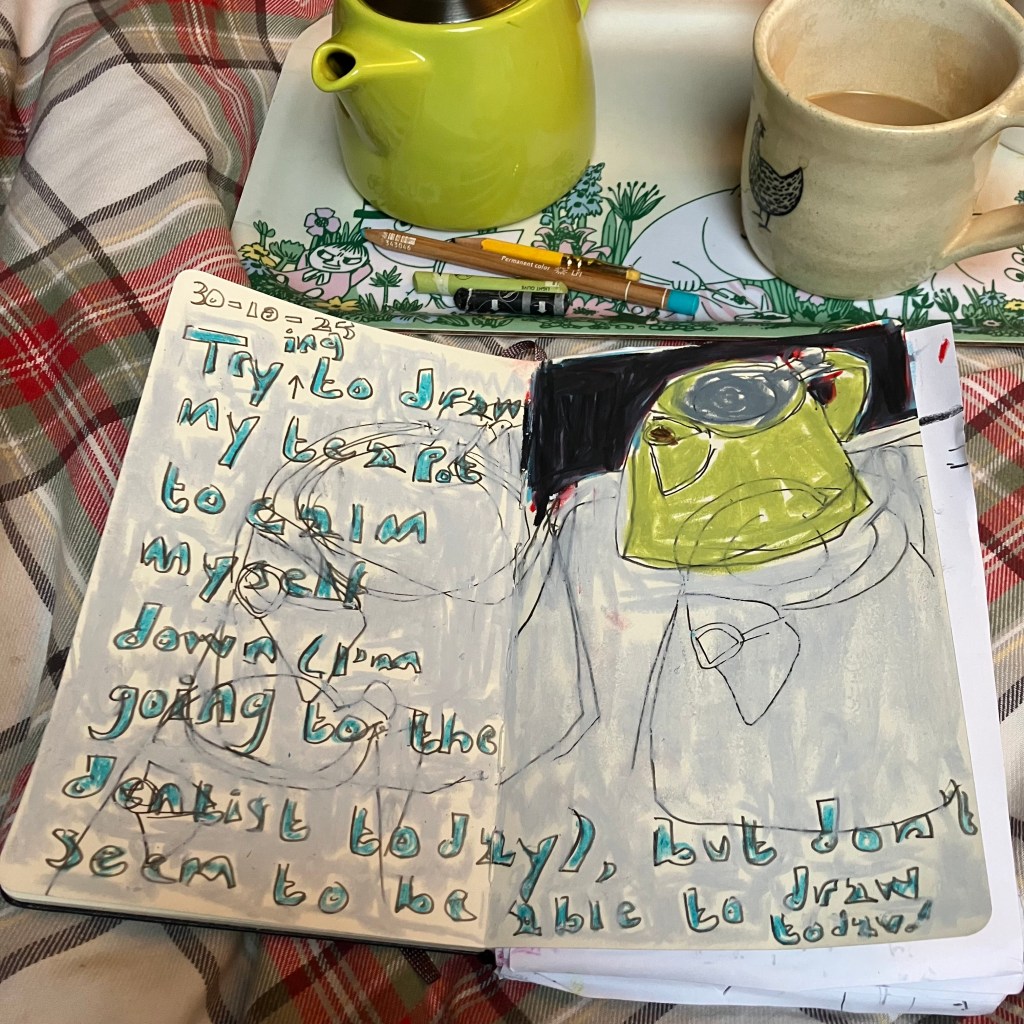
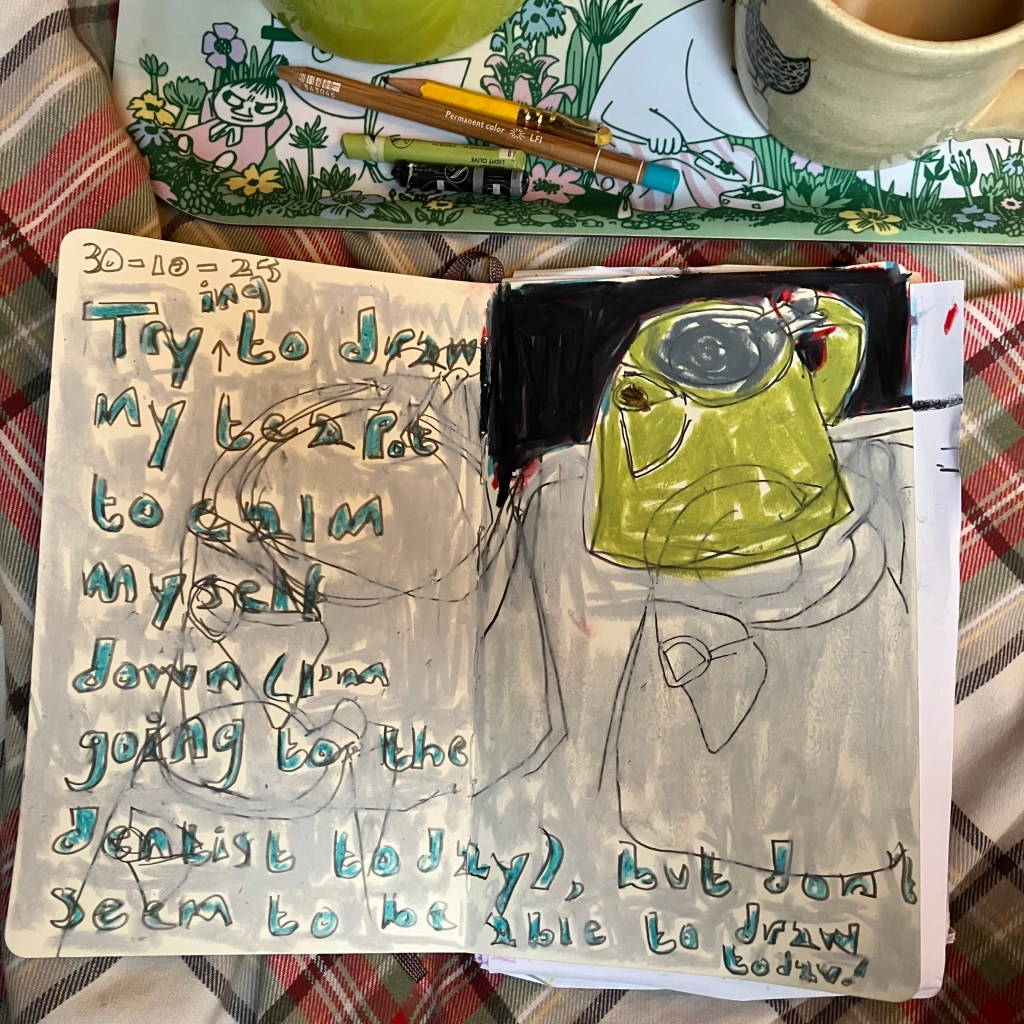
    An open sketchbook lies on a patterned blanket beside a tea-tray with a familiar lime green _Teapot For Life_ teapot, a comforting white _Louise Go Gently_ mug, and pencils. The pages show large handwritten text in turquoise-blue reading “Trying to draw my teapot to calm myself down (I’m going to the dentist today!), but don’t seem to be able to draw today.” On the right page is a loose drawing of the same teapot in Light Olive and Grey, set against a background of Silver Grey Neocolor and dark scribbled marks. The whole scene conveys a mix of anxiety and tenderness — an attempt to find calm through drawing.

    I’d been okay last night, but this morning I woke up feeling very anxious about today’s dental appointment. Early-morning anxiety used to be a regular occurrence when I was first diagnosed with ME, and a more generalised social anxiety has followed me through my life — though I wasn’t always aware of it. I’ve always struggled with going to the dentist.

    I’d hoped that my current morning routine of making tea followed by making a drawing would help to calm me today, as it did to some extent yesterday. I decided to keep it simple and just draw my teapot — something I’ve done hundreds of times. But today nothing felt right. I tried to draw slowly, beginning with the teapot’s spout, then gradually adding the top of the pot, its handle and hinge.

    I’m not someone who worries much about perspective, but I do look for something that feels satisfying — something that works within its own small visual world. After three attempts, filling the page in ways I wouldn’t normally do, I found I was adding drawing anxiety to my dental anxiety. I drew one more version of the teapot and decided that it would have to do, no matter how it turned out.

    I added some colour to distinguish it from the earlier attempts, then layered a heavy scribble of Silver Grey Neocolor II over the top to partly obscure them. At that point I began to enjoy myself, and the drawing anxiety (if not the dental) began to recede. There’s something satisfying about those semi-hidden lines under the grey — a quiet record of my anxious searching for calm.

    Home now from my appointment and resting on the bed with a second pot of tea, the dental anxiety has passed. Perhaps it was an anxiety that no amount of drawing could dampen. But drawing could record it — and distract me for a while — and maybe that’s enough.

    The full text reads:

    Trying to draw my teapot to calm myself down (I’m going to the dentist today!), but I don’t seem to be able to draw today!

    A close view of the sketchbook page focusing on the teapot drawing. The familiar _Teapot For Life_ teapot is rendered in Light Olive and Grey, with black and red marks around the rim, set against a softly worked Silver Grey background. The turquoise handwriting in Chrysocolla Blue pencil is visible on the opposite page. Pencil and crayon lines show three earlier attempts to find the form. The image feels both unsettled and intimate — the drawing and words merging into a small act of self-soothing.

  • Listening to David Hockney

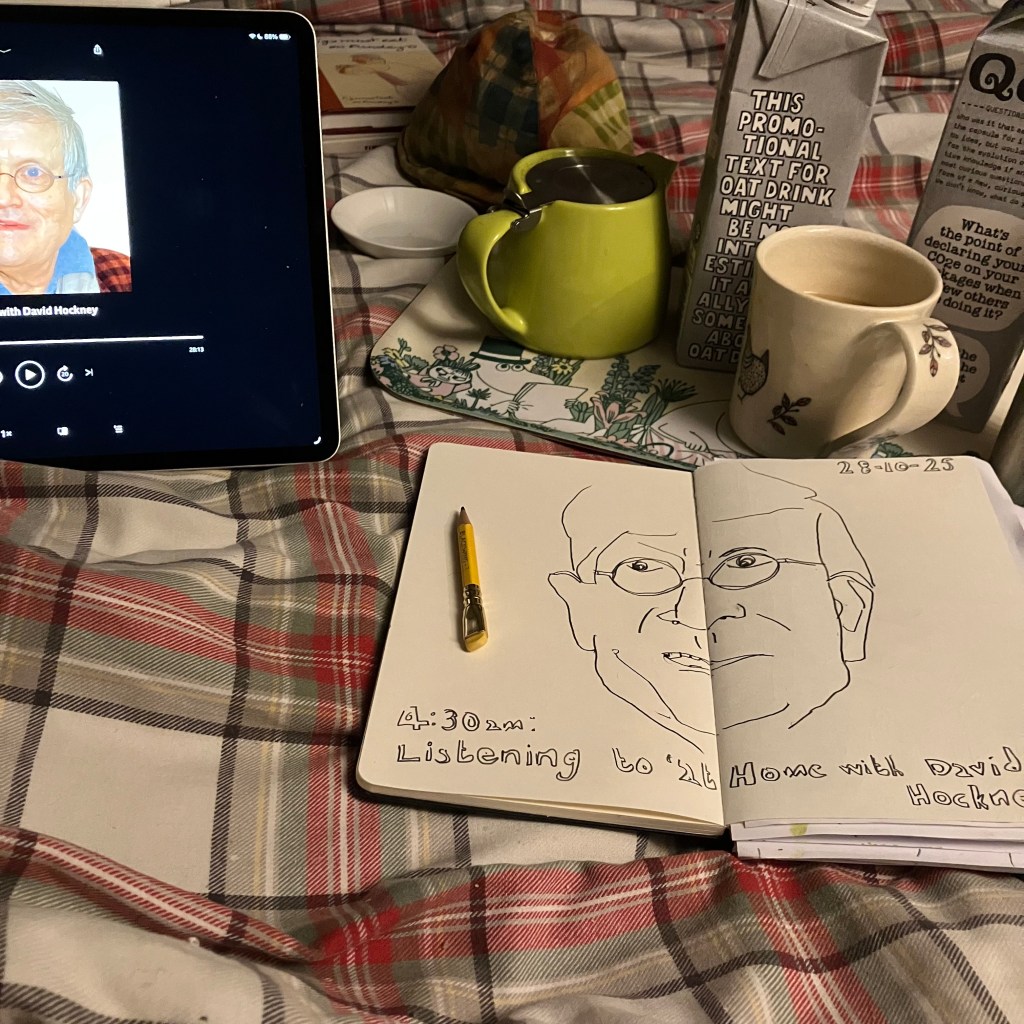
    A cosy night-time scene on a plaid blanket. An iPad displays a portrait of David Hockney from the BBC Sounds programme At Home with David Hockney. Beside it sits a Moomin illustrated tray holding a green teapot, jug, and a mug, with two oat-milk cartons behind. In the foreground lies an open sketchbook showing a simple line drawing of Hockney’s face spread across two pages, captioned “4:30 a.m: Listening to ‘At Home with David Hockney.’” A short pencil rests on the page. The image conveys the quiet companionship of drawing and listening in the early hours.

    Drawn in the early hours while listening to At Home with David Hockney.

    My energy is especially low today (after buying a car yesterday!) and I wasn’t sure if I was up to drawing at all. But there’s always something about being awake and making a tray of tea things to bring back to bed that nudges me toward reaching for my sketchbook — a habit attached to a habit that is hard to resist (even when energy is very low!).

    Listening to David Hockney in the dark felt companionable. Among other things, he talked about how looking takes time — how we don’t see everything at once, and how a picture can hold that slow seeing.

    I loved his reminder that “the more you look, the more you see.”

    His life, like mine is very small and mostly home-based. He talked about he only leaves the house to go to medical appointments, his local bookshop and the marijuana shop. No marijuana shop here — and replace his bookshop for my library — and our lives look very similar. As with what Tracey Emin was saying a few days ago, I found this very comforting…

    I enjoyed making this drawing — just a simple line drawing. It felt less daunting than tackling a full Tea-Tray drawing today when my energy is so low, and I felt calm listening and drawing.

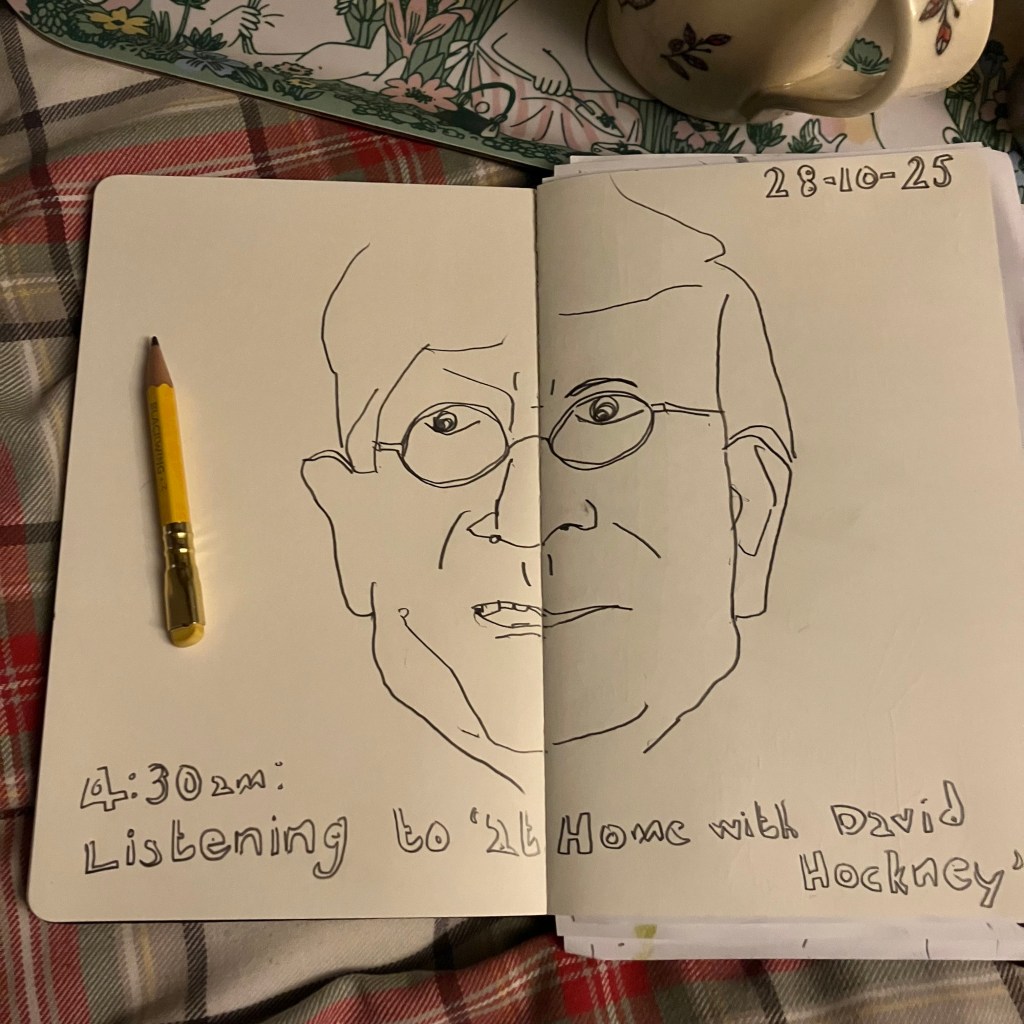
    I don’t think I captured David, but I love the lines (and now the memory of making them).

    A close-up view of an open sketchbook resting on a plaid duvet cover. The page shows a simple line drawing of David Hockney’s face spread across two pages, dated “28-10-25.” Below the portrait, handwritten text reads “4:30 a.m: Listening to ‘At Home with David Hockney.’” A short yellow Blackwing pencil lies on the left-hand page. The corner of a Moomin illustrated tray and a mug are just visible at the top, suggesting a quiet early-morning drawing session in bed.

  • Sometimes Things Just Can Work Out

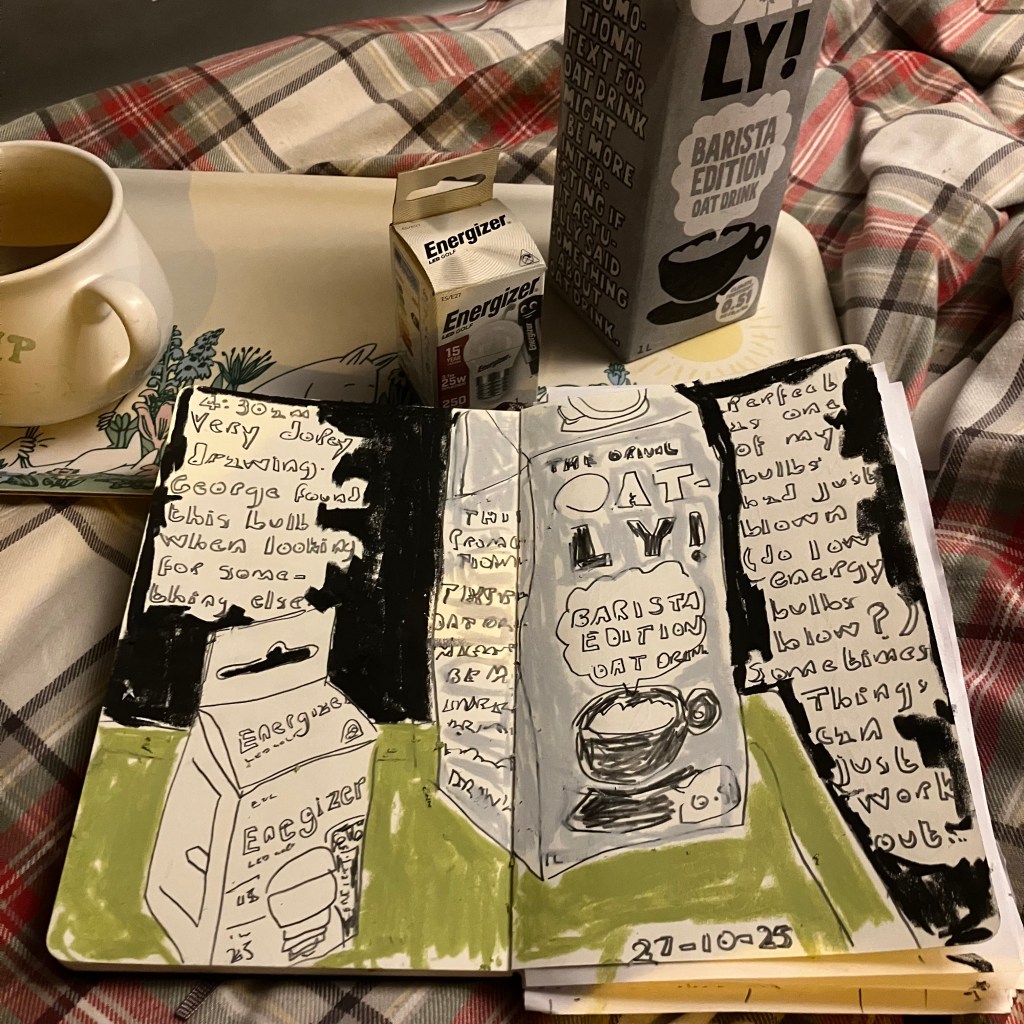
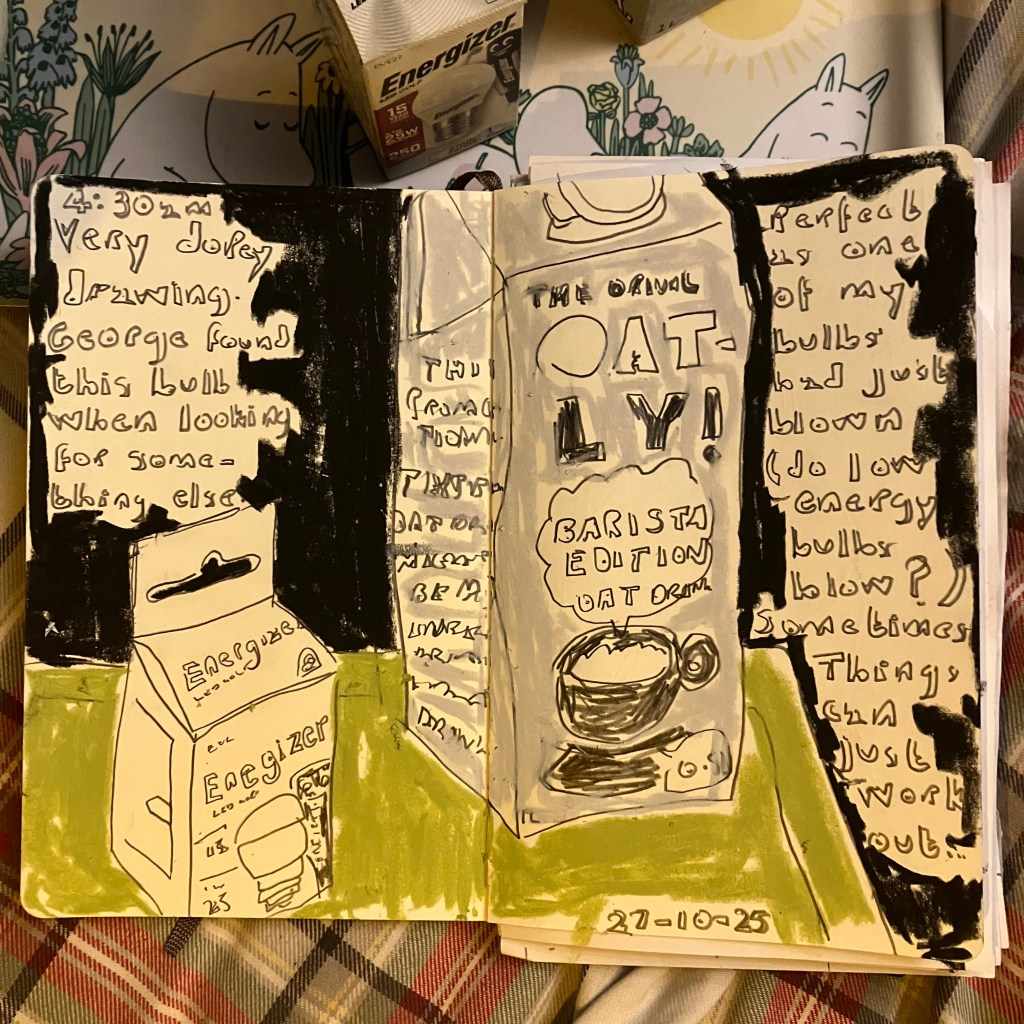
    A close-up of an open Moleskine sketchbook showing a late-night drawing of an Oatly Barista Edition carton and an Energizer light bulb box on a green surface (the tea-tray). The handwritten text records a 4:30 a.m. moment when George found a replacement bulb just after one had blown. The drawing was made with a Blackwing 3 pencil and two Neocolor II crayons (black and light olive). The real objects — carton, bulb box, and Onion Soup mug — rest on the tea tray behind the sketchbook, all on a plaid blanket. The image conveys quiet domestic calm and the small satisfaction of things unexpectedly working out.

    Today’s Tea-Tray drawing, made at 4:30 a.m. when I couldn’t sleep.

    An Oatly Barista carton, an Energizer light bulb box, and my Onion Soup mug were all on the tea tray, though the mug didn’t find its way into the drawing.

    G. had just found the bulb while looking for something else, moments after one of the lights blew — a small thing, but it felt like a sign that maybe not everything has to be difficult. I was about to put the bulb box into the recycling and then decided I could draw it instead. A tiny decision, but one that changed today’s drawing from my more usual composition. (I’m going to put the bulb box into my physical Ephemera archive.)

    It was drawn with my Blackwing 3 pencil and two Neocolor II crayons (black and light olive). I felt very dopey and suspected I wasn’t equal to the task, but I’m glad I persevered — so that now this drawing exists as a tiny record of a quiet moment of domestic calm, and the small satisfaction of things unexpectedly working out.

    The full text reads:

    4:30 a.m.
    Very dopey drawing. G. found this bulb when looking for something else. Perfect as one of my bulbs had just blown (do low-energy bulbs blow?). Sometimes things can just work out.

    A closer view of the drawing in the sketchbook, showing the loose pencil and crayon lines depicting the Oatly carton and Energizer bulb box. The handwritten notes describe tiredness, coincidence, and the relief of a small thing going right. The textures of pencil and crayon are visible on the paper, revealing the dopey, half-awake energy of the 4:30 a.m. drawing.