Tag: art

  • A broken pencil at 3.00 am

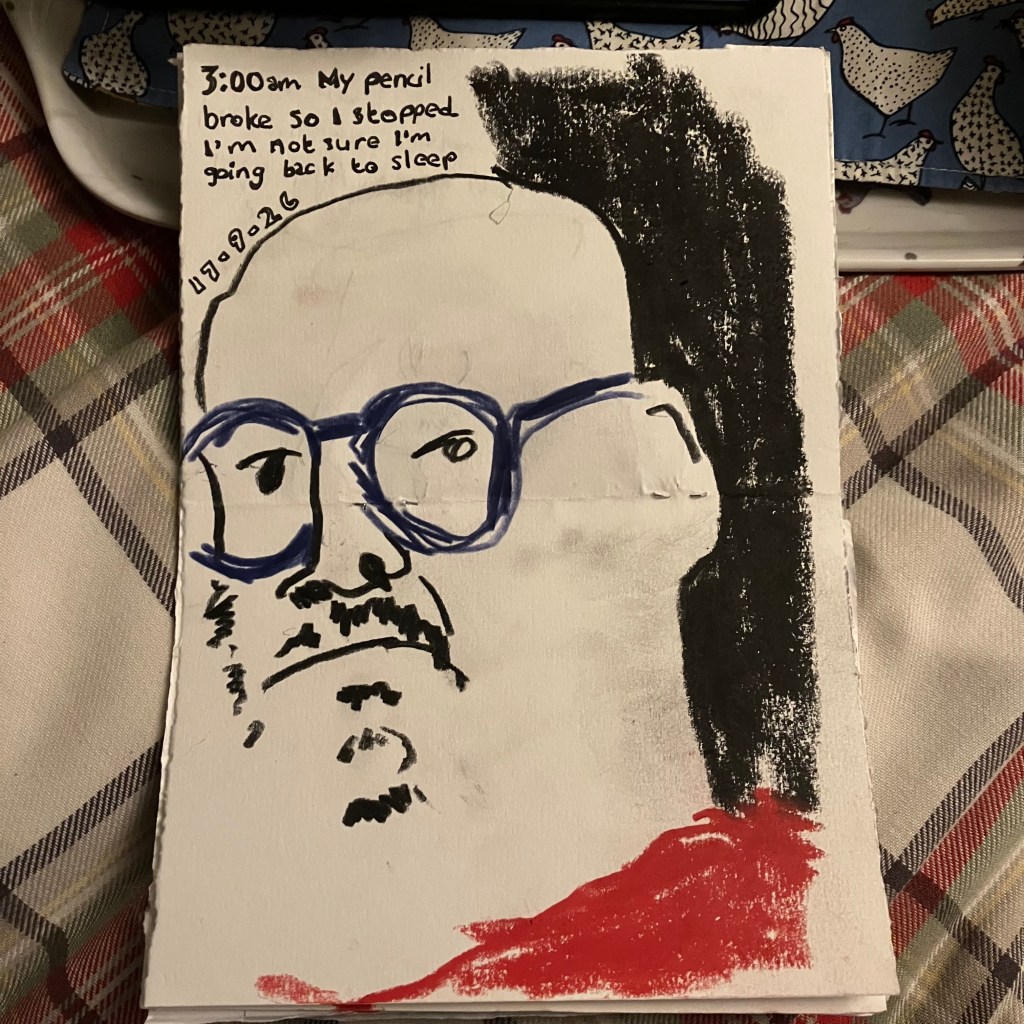
    A close-up of a small homemade sketchbook page containing an early-morning self-portrait. The face is partly drawn in black with bold blue glasses, dense black hair and a red area at the bottom of the page. The handwritten note at the top reads, “3:00am My pencil broke so I stopped. I’m not sure I’m going back to sleep.”

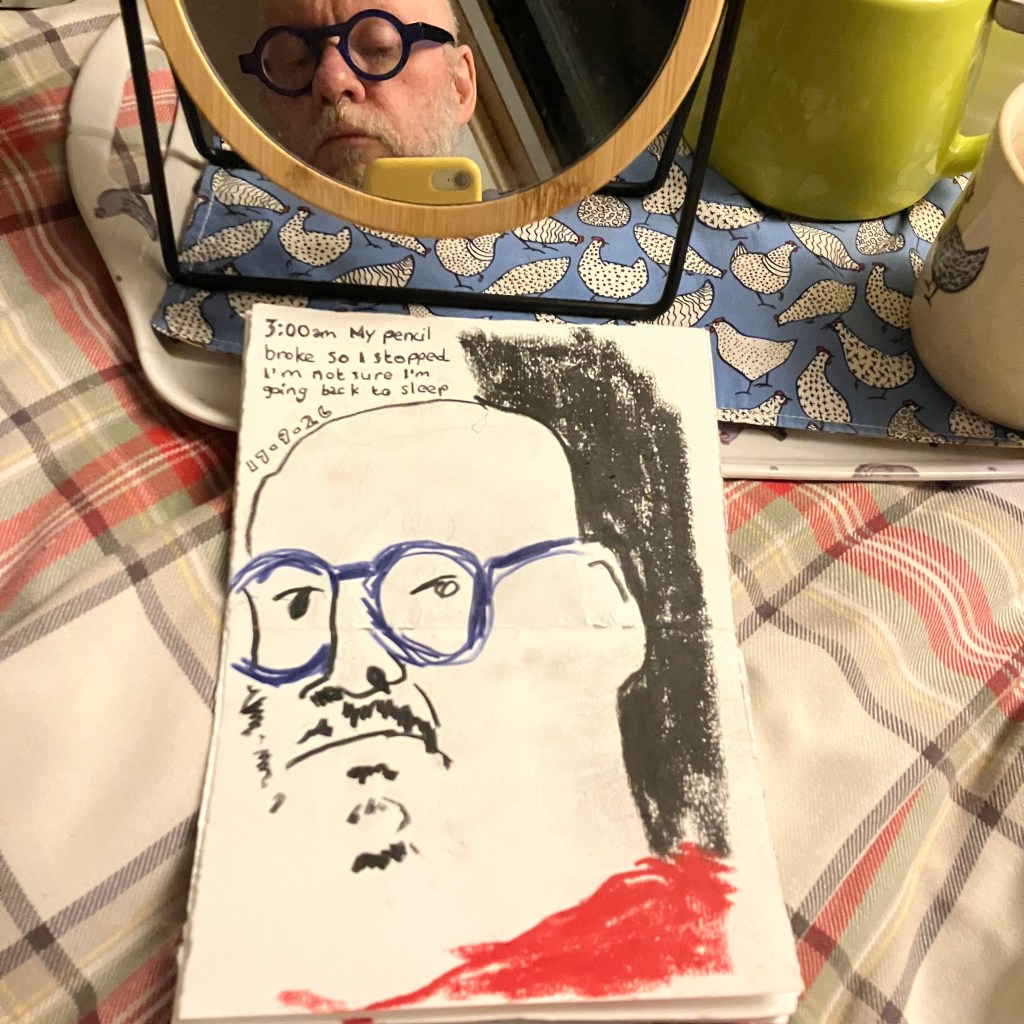
    I was following my current early-morning drawing compulsion of pouring out my tea and reaching for my mirror and sketchbook. It was even earlier than usual — 3.00 am today — and I’d rather have still been sleeping. But the rule seems to be: I wake up, make tea and draw myself. So that’s what I was doing.

    When the pencil broke

    Midway through drawing, the lead of my pencil broke. I’d been using a rather lovely old and waxy Derwent Drawing pencil in Ivory Black and enjoying the heavy, pastel-like quality of its lines. It was as I was working the pencil hard, drawing the now familiar line of my mouth, that the lead simply crumbled. In that moment, the spell was broken and I was able to stop drawing.

    I realised I liked where the drawing had ended and decided to leave it where it was. Switching to a pen, I grounded the drawing in the moment with an early-morning report in the corner.

    I think — and this is new — even though the drawing was “unfinished”, being forced to stop meant my compulsion to draw had been quenched and I was able to relax into being awake and drink my tea.

    A second drawing

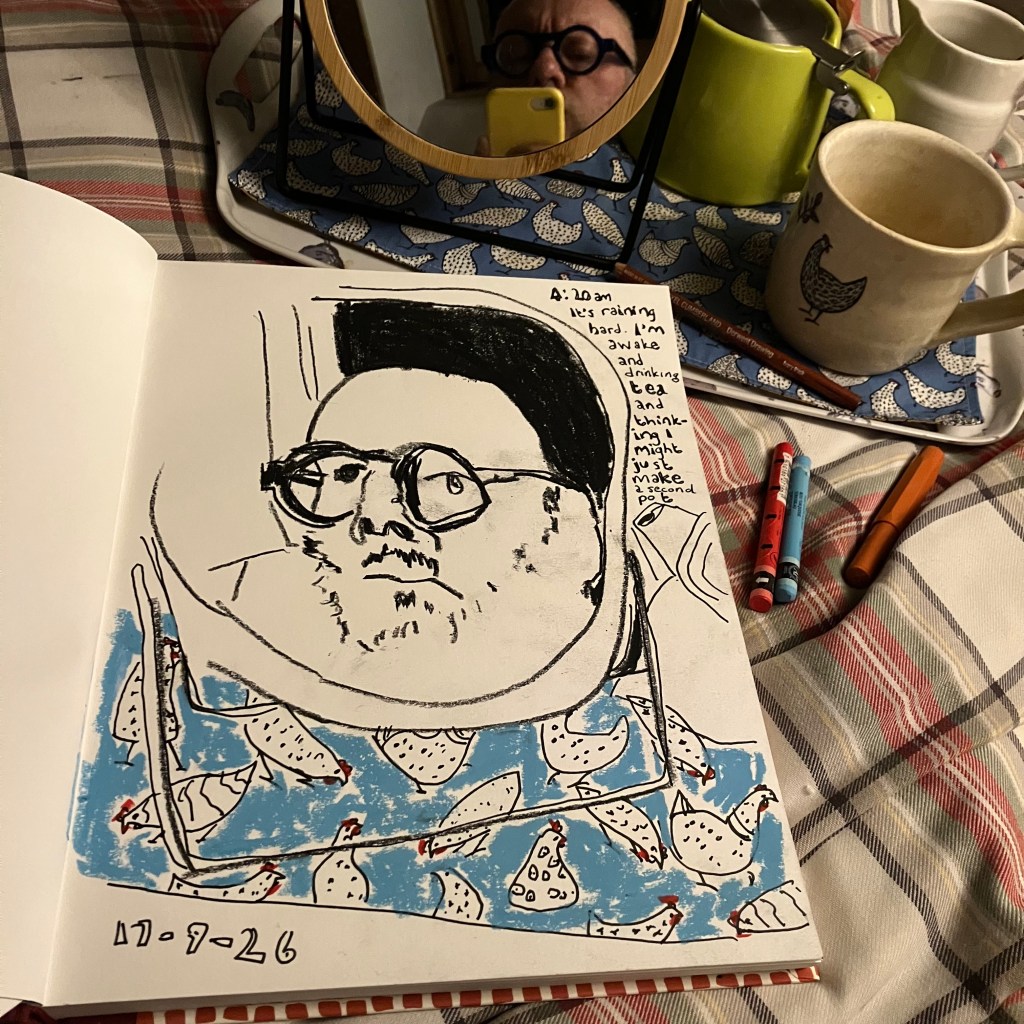
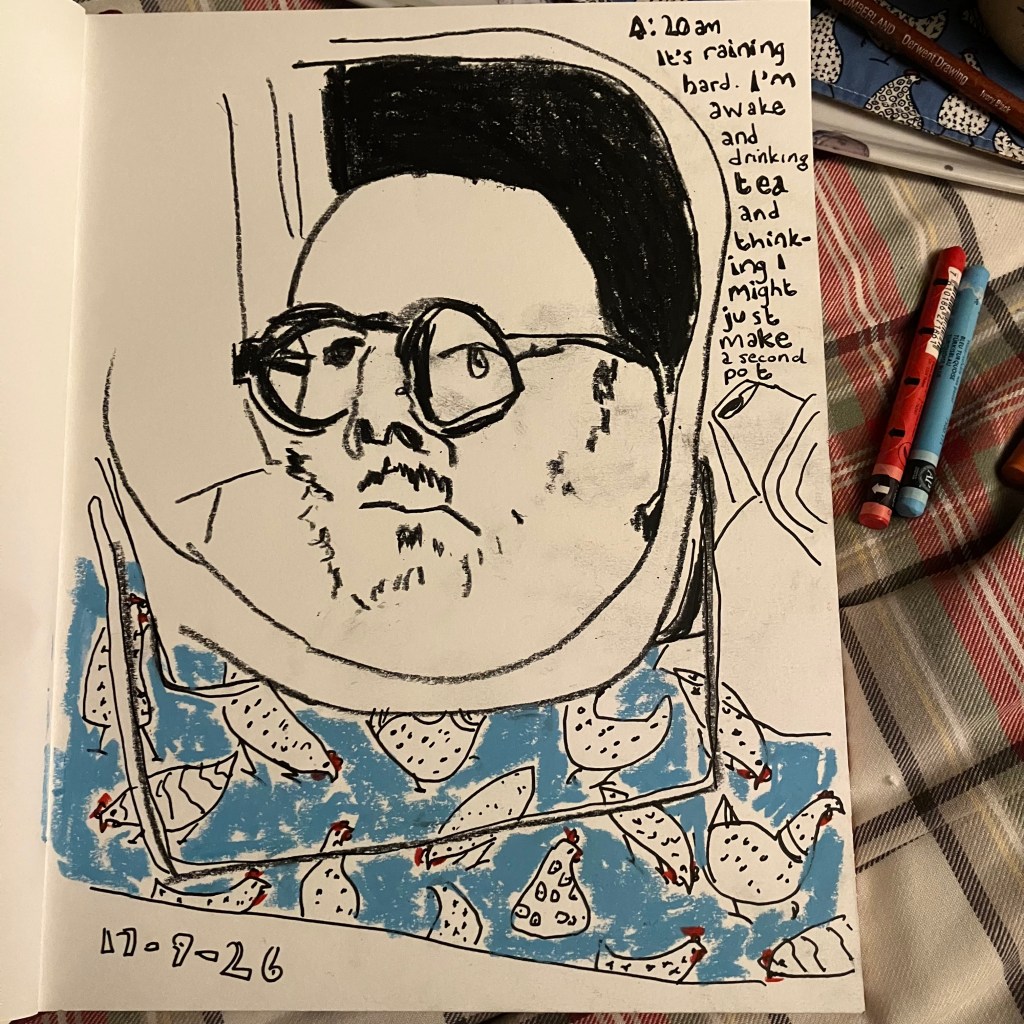
    After a little while, I reached for my newly started A4 Fabriano sketchbook and began another drawing, not because I needed to, but because I wanted to. This time I drew slowly, probably for about an hour, stopping regularly to enjoy my tea and notice the sound of the rain on the window above my head.

    Something interesting happened with this drawing. The self-portrait was drawn first, with the now-sharpened Derwent, much as I’ve been drawing them these past couple of weeks. But then I switched to my broad-nibbed Kaweco Sport and returned to the very familiar language and materials of my tea-tray drawings. It was as if these two, until now separate ways of drawing, met for the first time.

    At 4.20 am I added a few words to ground this drawing too: It’s raining hard. I’m awake and drinking tea and thinking I might just make a second pot.

    In the end I didn’t. I fell asleep instead.
  • Drawing Mary (upside down)

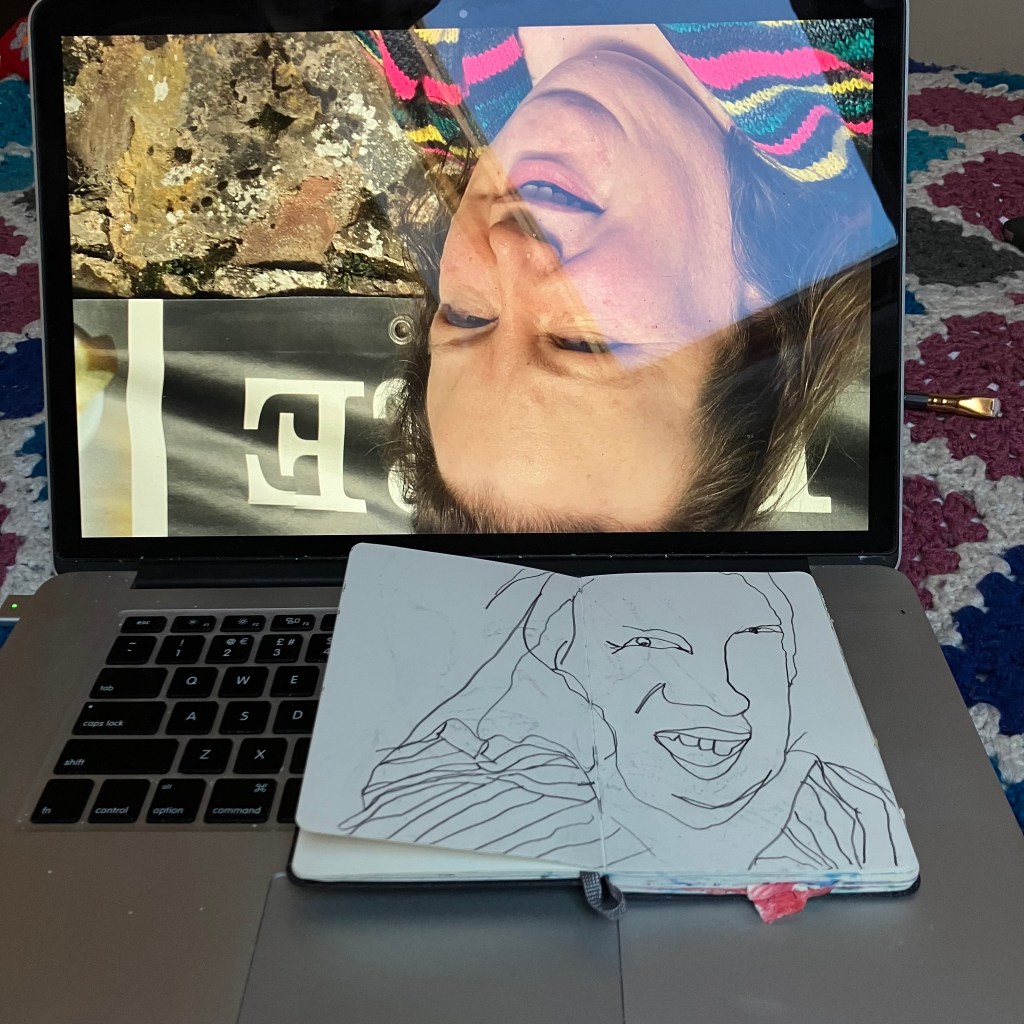
    A laptop resting on a crocheted blanket, showing an upside-down photograph of a woman outdoors, against a stone wall, wearing a striped jumper in bright colours. In front, a small open sketchbook lies on the keyboard, displaying a loose line drawing of the same face. A pencil rests nearby.

    A beginning — or a returning

    This feels like an important drawing — the first I’d made in nearly ten years after suddenly stopping drawing in 2013. It’s of my dear friend Mary, who had just died.

    Hearing the news — and knowing I needed to draw

    In my grief after hearing she had died, I was sent into quite a spin about my own mortality, and I realised with a sudden shock that I didn’t want to die myself without drawing again. I went into town looking for the familiar — the pocket-sized Moleskine sketchbook I used to draw in many years ago — but I couldn’t find one.

    I ended up ordering one from Amazon that same afternoon.

    The invoice — and what it showed me later

    I’ve just found the invoice — dated 10th March 2023 — the very day I received the message telling me she’d gone. That was how urgent getting hold of that familiar sketchbook, and making a drawing in it, must have felt.

    According to the invoice, it arrived the next day — so this drawing could have been made on or around the 11th of March 2023.

    Why upside down?

    It is an upside-down drawing, following an exercise from Betty Edwards’ excellent Drawing on the Right Side of the Brain. The exercise — turning a photograph upside down to draw from, so the brain is tricked into really looking at what’s there — felt like a gentle way back into drawing after so many years.

    Looking back, I think I also needed Mary herself to be upside down so I wasn’t looking directly at my lovely, now dead, friend. That slight detachment helped me see only shapes and lines, rather than the full weight of grief.

    A drawing that felt like me

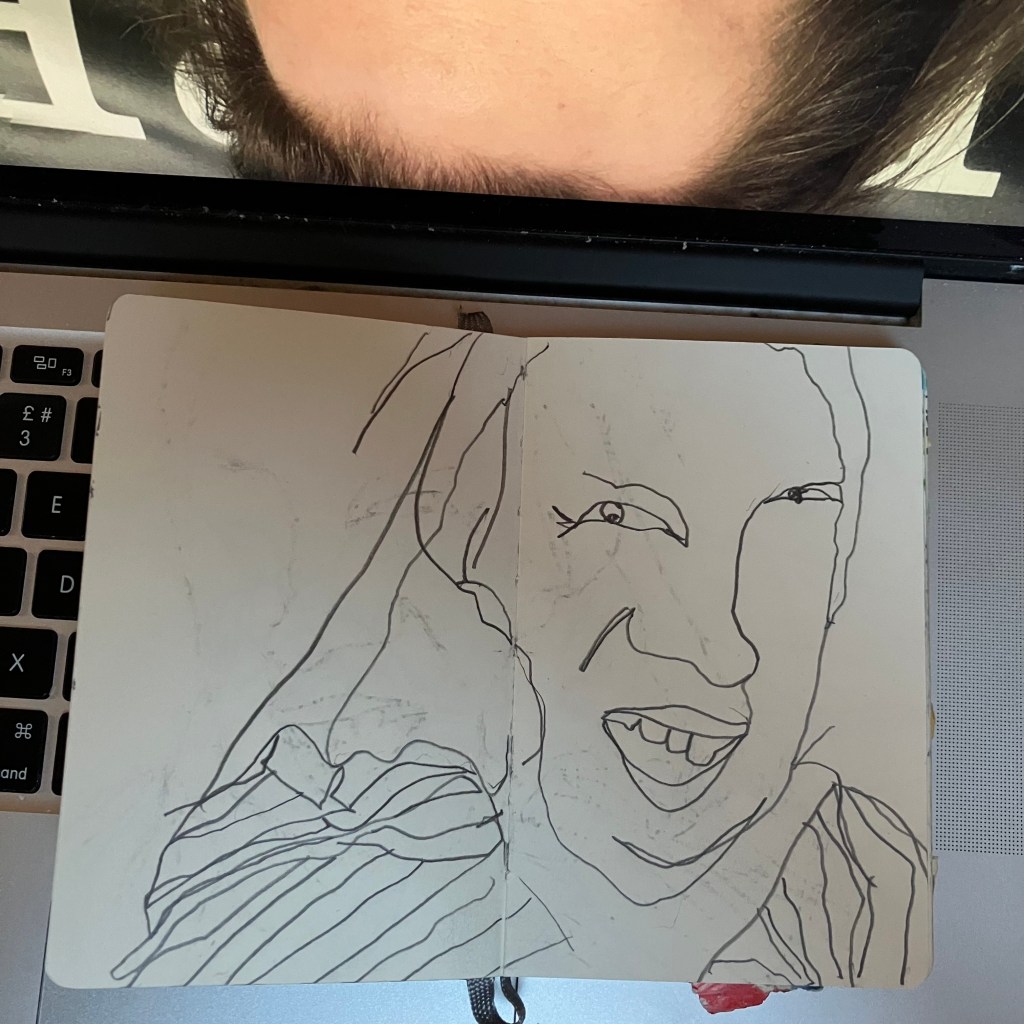
    Unlike most of the rest of that sketchbook, this drawing looks more like the drawings I’m making today (and the ones I was making back in 2013). The marks feel very me — in their quickness and weight. Most of the other drawings feel nervous and uncertain. This one, though — this one feels like me finding myself again.

    Why it mattered — then and now

    The drawing mattered then because it was proof that I could still make a line. That drawing itself was something I hadn’t lost — not completely. It mattered because it was a beginning — or maybe more accurately, a returning — even though I didn’t, or couldn’t, trust that at the time.

    It matters today because I can see what I couldn’t quite see then: this drawing quietly held both loss and return. It was an opening — quiet, unannounced, and upside down. A small act of mark-making that allowed all the others to follow.

    See also: Finding out that Mary Gordon had died and Moleskine Invoice

    A small open sketchbook lies on the keyboard of a laptop. On the laptop screen, an upside-down photograph shows part of a woman’s forehead and hair. The sketchbook page contains a loose line drawing of a face, with bold outlines defining the eyes, mouth, and clothing folds. The surrounding area is softly lit and uncluttered.
  • Dealing With Last Page / First Page Anxiety

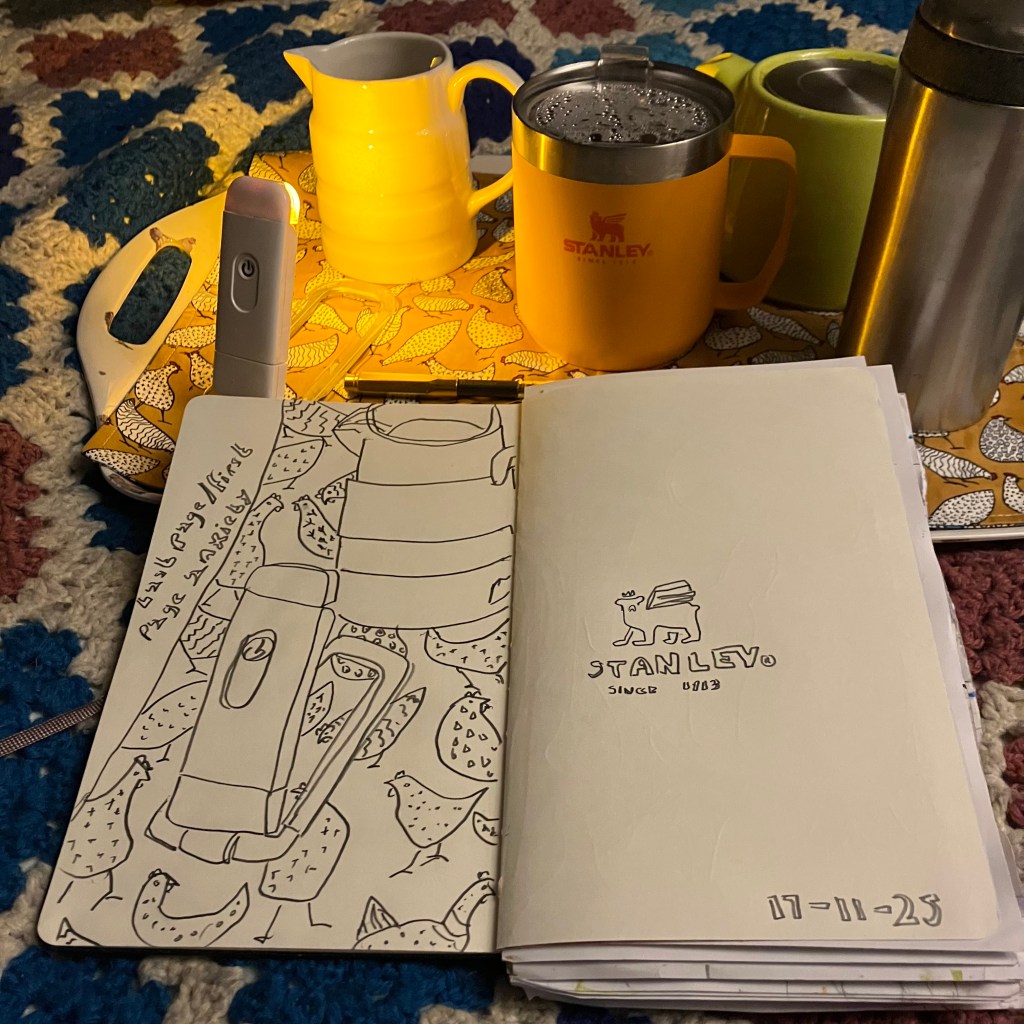
    A view of a tea tray arranged on a bed covered with a crocheted blanket. On the tray is a patterned hen tray mat, and resting on the mat are a white milk jug, an orange insulated mug, a tall stainless-steel flask, a lime-green teapot, and a slim reading light rising just behind them. In front of the tray lies an open sketchbook. **On its left page is a dense pencil drawing of some of the items from the tray — the reading light and the milk jug — shown sitting on the hen-patterned mat.** On its right page, centred within a large area of blank paper, is a small hand-drawn version of the Stanley logo — a winged bear wearing a crown — with “STANLEY. Since 1913” written beneath it. Warm lamplight falls across the scene.

    This morning I woke with a tightness around the idea of making my morning drawing — a physical resistance to picking up my sketchbook. I’ve been working backwards through this sketchbook, so although I’d reached what was, for me, the final blank spread, it was also the first pair of pages after opening the cover. I’d been feeling it coming for days and, unusually, it had been haunting me.

    I’ve been working this way through sketchbooks for more than two and a half years — since I first returned to drawing after Mary Gordon died. It was a strategy born out of needing to avoid the paralysing pressure of a perfect first page. At first I simply chose random places to draw, but soon I settled into working from back to front. It has served me well, but with this sketchbook that first-page paralysis has reared its head again — maybe because of the recent stress around my health and all the newness.

    Interestingly, in worrying about meeting this page, I’d forgotten about the power of routine. Simply making my tea, arranging my tea-things on the tray, and bringing it back to bed found me reaching for my sketchbook and pencil and beginning to draw. I stayed gentle and started with something small and contained: the Stanley logo on my insulated mug. I’ve been wanting to draw it for a while, and its sparseness felt like the right entry point. Once that was on the page, the drawing grew easily — the reading light, the illustrated hen mat, the milk jug. Familiar shapes. Familiar company.

    I decided not to add any colour, and as I dated the drawing to mark it as finished, I felt a quiet satisfaction at having made it through that moment of resistance — and at having filled another sketchbook, one drawing at a time, from back to front.

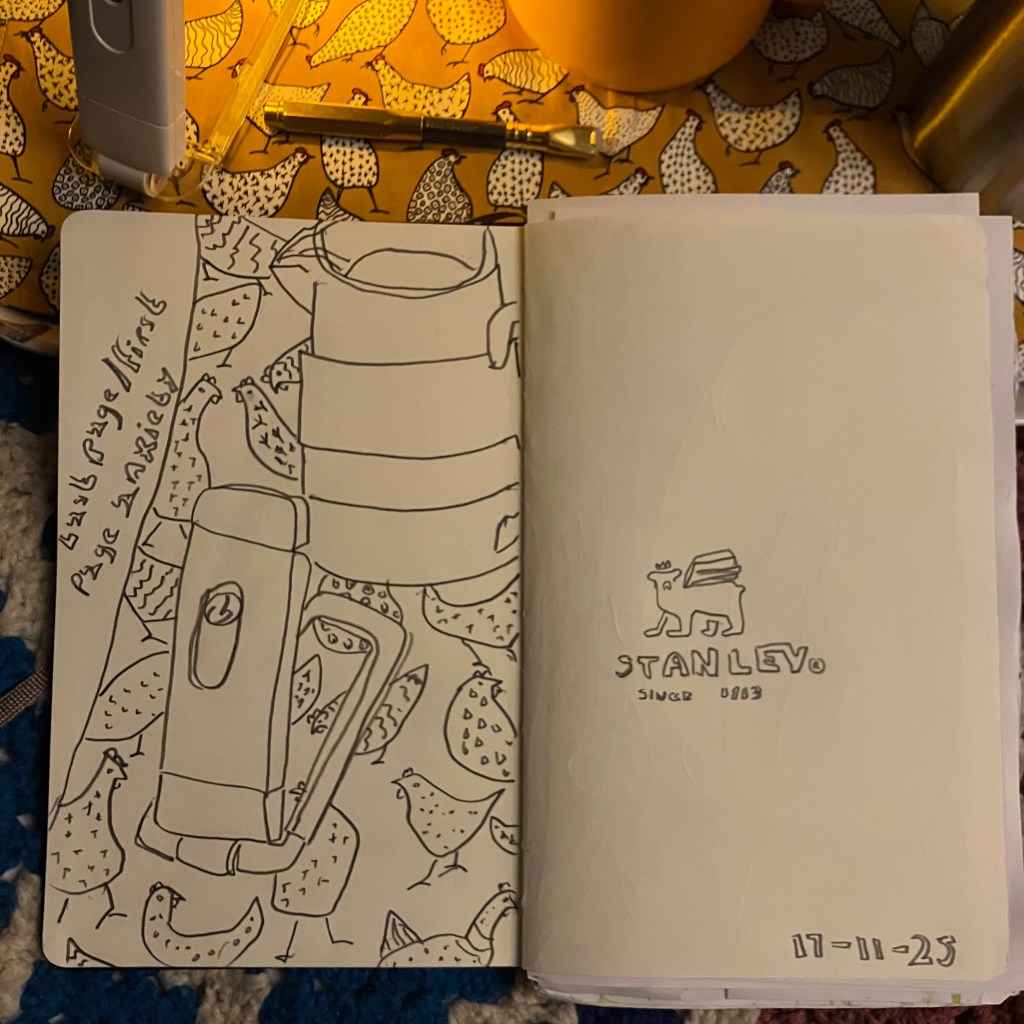
    A close-up view of an open sketchbook resting on a bed. On the left page is a dense line drawing made with pencil showing a reading light and a milk jug, both sitting on a patterned hen tray mat. The hens form a repeating background across the whole page. On the right page, centred within a large area of blank paper, is a small hand-drawn version of the Stanley logo — a winged bear wearing a crown — with “STANLEY. Since 1913” written beneath it. The date “17–11–25” appears in the lower corner. 

Above the sketchbook the edges of the tray from the drawing can be seen showing the base of the reading lamp and part of the hen patterned tray mat from the drawing, along with a short pencil with a gold point guard and what looks like the base of an orange mug and a silver flask. Warm lamplight softens the edges of the paper.

  • Drawing in the Dark (Again)

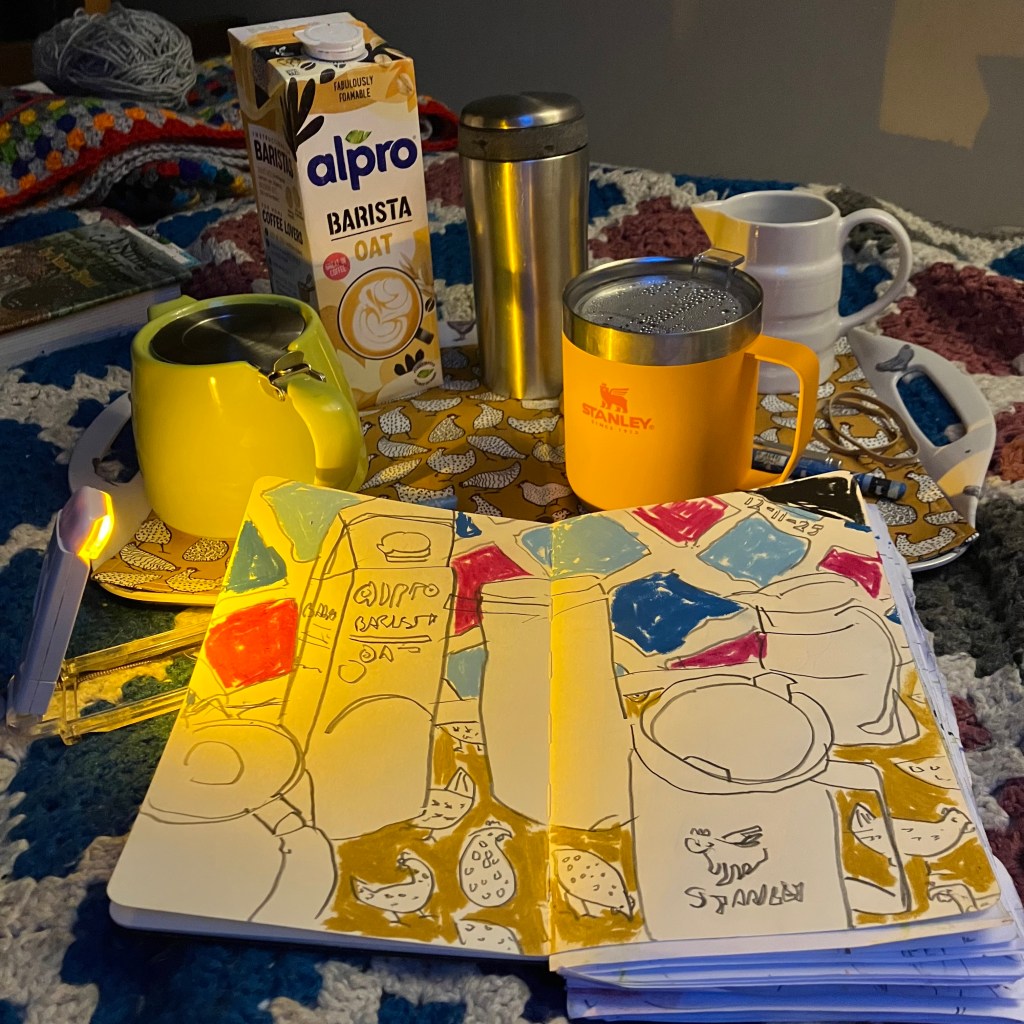
    A softly lit tea-tray scene resting on a crocheted blanket. On the patterned tray are a lime-green teapot, orange Stanley mug, stainless-steel flask, and a carton of Alpro Barista Oat milk. In front of them lies an open sketchbook showing a bold drawing of the same objects, partly coloured with red, blue, and ochre Neocolor crayon. A small lamp casts a warm yellow light across the page and teapot, turning the whole arrangement into a cosy night-time study in repetition and reflection.

    I was excited to pick up my sketchbook this morning. After yesterday’s experience of drawing in the dark, I was keen to experiment a little more.

    Only a little light

    There was a small pool of light cast from my bedside reading lamp to the left, but the tray in its usual position on the bed was mostly in darkness. I could just make out the familiar shapes of the things on it, but much wasn’t clear.

    I began with the ninety-degree Perspex handle on the lid of my new bright orange insulated mug. I drew the gentle curve of the top of the mug and immediately felt the comfort and pleasure that can come from drawing. I couldn’t see the shape of the mug’s handle, so I drew that from memory — and did the same with the Stanley motif on the front.

    Next came the flask, drawn a little less clumsily than yesterday, and the milk jug — a mix of what I could see and what I remembered from drawing it so many times before. Then the oat-milk carton. The top half was lit better and I could observe it directly, but this wasn’t my usual brand, so when I reached the darker lower half I left much of it undrawn. Then my teapot: familiar from memory, but not quite right.

    Choosing colour by instinct

    Finally I added the crocheted blanket the tray was sitting on. As yesterday, I chose colours without seeing them clearly — relying on the remembered length of each crayon and a sense of how light or dark it felt. I did better at choosing today, though I didn’t know for sure which colours I’d picked until daylight began to seep into the room.

    At first, I hadn’t planned to include the illustrated hens on the mat (or to colour it), but I was enjoying the session and gaining confidence in drawing from memory. As the room brightened, I could make out the white shapes of the hens, though not their details, so I added a few approximations. To finish, I coloured the mat with what I hoped was a Neocolor II Ochre crayon — it was.

    A litte fiddling!

    When I decided the drawing was finished, I realised there wasn’t much space left to add the date, so I tucked it into one of the white borders of the crocheted blanket squares. Unable to stop myself fiddling (and breaking my rule of the drawing being finished when I add the date), I added a couple of small touches of colour where I’d missed before — the only moment of dissatisfaction in an otherwise deeply satisfying drawing.

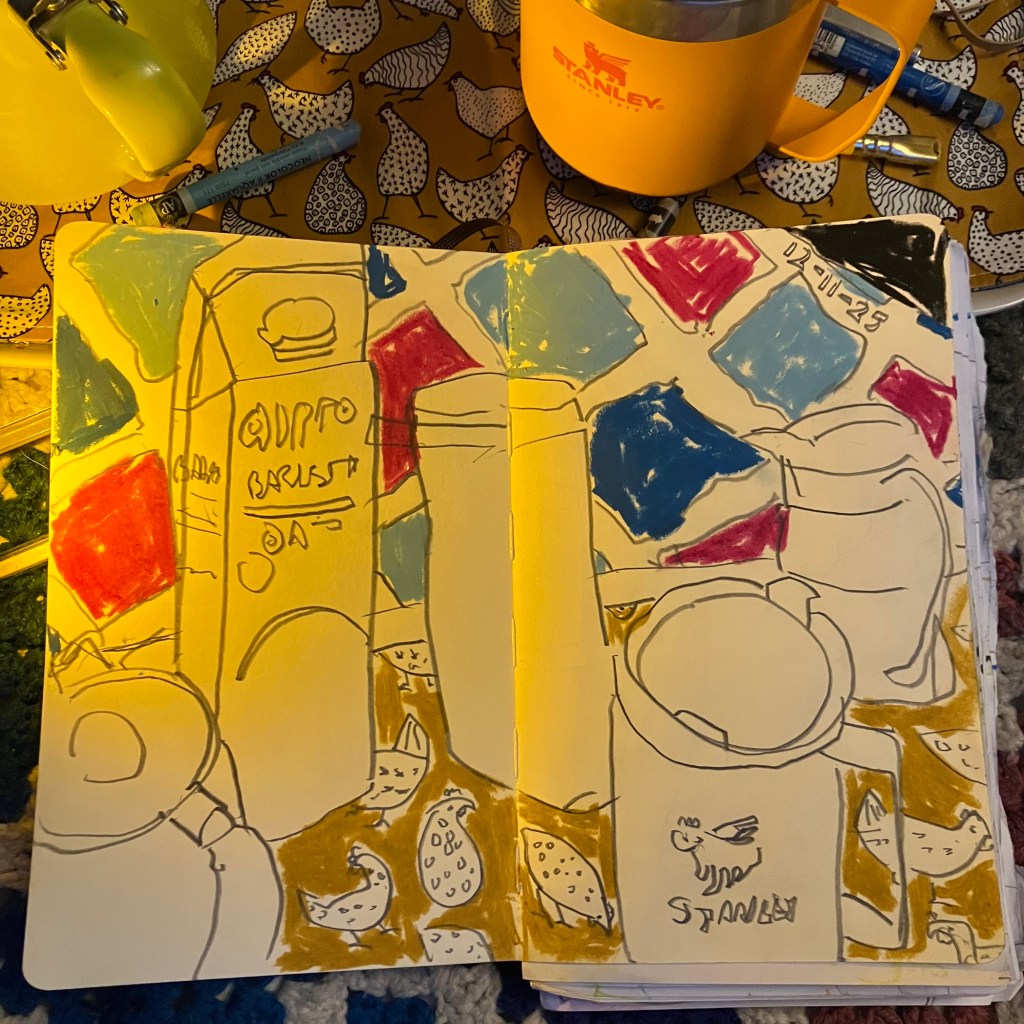
    A closer view of the open sketchbook resting on the tray, its pages filled with a line drawing of the morning tea-tray — the Alpro carton, flask, teapot, and Stanley mug — outlined in black and filled with bright blocks of ochre, red, and blue. The yellow lamplight gives the page a golden tone, echoing the warmth of the objects around it. The date “12-11-25” appears in the top corner, anchoring the drawing as part of the ongoing Tea-Tray series.
  • Drawing Through a Transition and a New Understanding

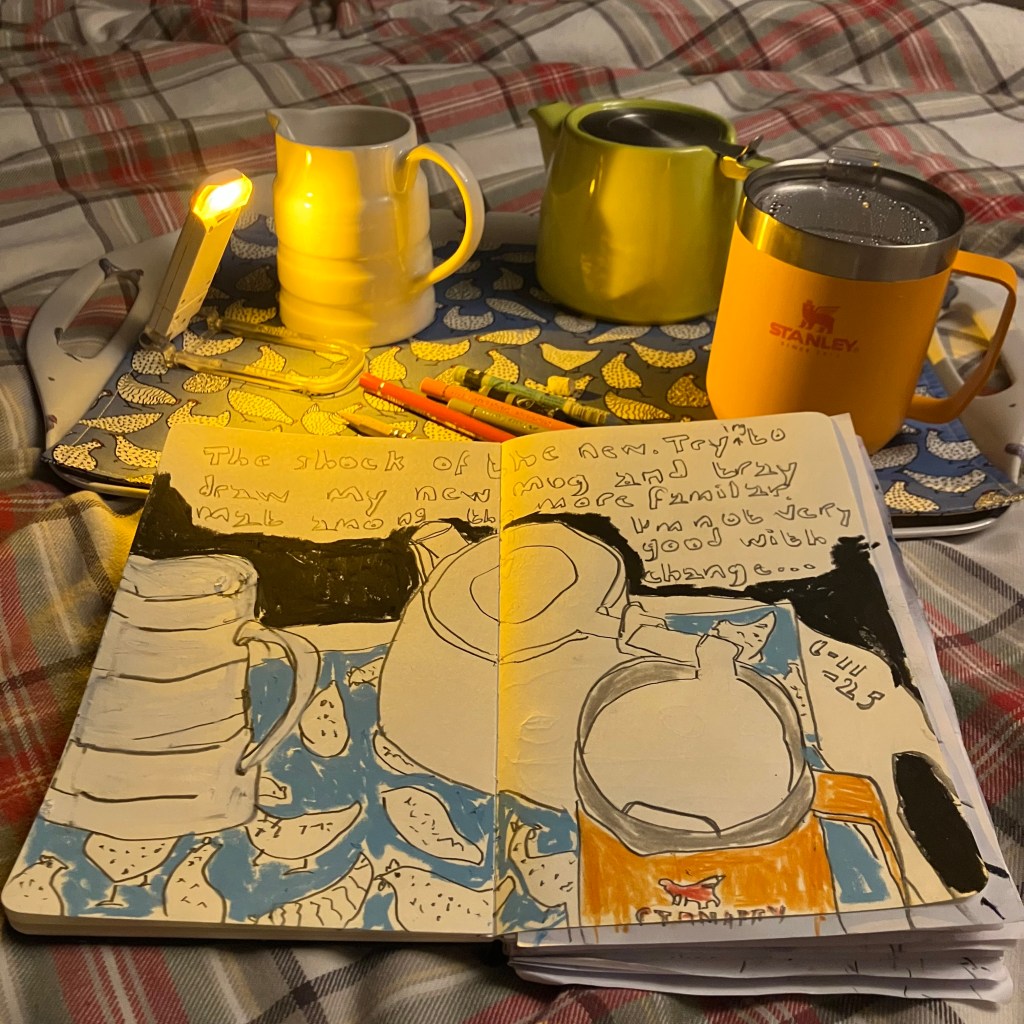
    An open sketchbook lies on a bed beside a tray. On the tray are a white ridged jug, a small green teapot, and a bright orange insulated mug on a chicken-patterned mat. The drawing in the sketchbook depicts these same objects and their arrangement. Coloured pencils and a small reading light are nearby. The scene is softly lit with warm, indirect light.

    Two new things in my world

    When something changes in my small daily world, it can feel larger than it might seem to someone else. I often need time to learn how to be alongside the new thing — to find its place and let it find mine. Drawing can help with this — not always straight away or with one drawing, but over time, drawing by drawing, I can begin to feel comfortable with the new and unfamiliar.

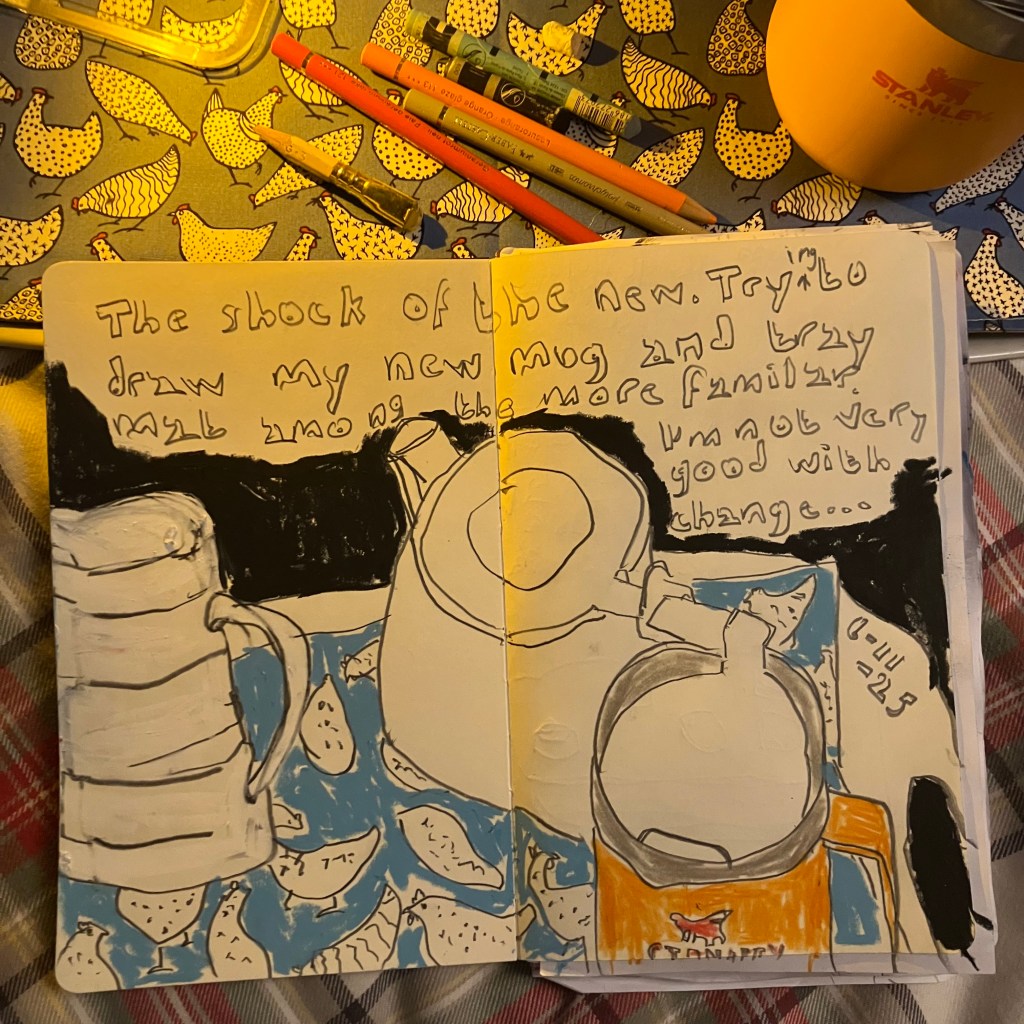
    Today’s drawing, The Shock of the New shows the start of a transition. I have a new bright orange mug and a new turquoise tray mat covered with small white chickens. I really love them both, but on my tray, in this drawing, they both felt out of place — loud, jarring and too new.

    Drawing through the discomfort of transition

    In the drawing, the new mug appears only partly on the page, as though it hasn’t quite entered the familiar world of the drawing yet. The chickens on the tray are clumsy — my hand doesn’t know their shapes, so it feels its way slowly, uncertainly. Nothing is fully settled. I am still working out how these new things belong.

    As I stayed with the drawing, I noticed that something began to shift a little. The new objects didn’t feel comfortable, exactly — but they felt less abrupt. I wasn’t trying to make them fit, but I was enjoying exploring them and and feeling the possibility that they might.

    What I’m beginning to understand

    I’m beginning to see that drawing helps me move slowly through a change, to sit with the discomfort of it, and to let something unfamiliar become part of my world. In that sense, it is a therapeutic process.

    More than that, I’ve realised today (with a quiet shock of recognition) that my recent drawings have also been revealing a little more about me than I had quite seen before. I think that understanding is part of another transition and I need to let it arrive slowly too — drawing by drawing.

    A close view of an open sketchbook page showing a line drawing of objects on a tea-tray: a ridged jug, a small teapot, and the upper portion of a tall insulated mug. The tray mat beneath them is turquoise and patterned with small repeated white chickens. Areas of flat colour appear in turquoise, black, and orange. At the top of the page, handwritten text reads: “The shock of the new. Trying to draw my new mug and tray mat among the more familar (sic). I'm not very good with change.” The image is lit by a soft orange light, which may be somewhat altering the appearance of the colours.
    The Shock of the New (6th October 2025)