Tag: DailyPractice

  • On auto-pilot

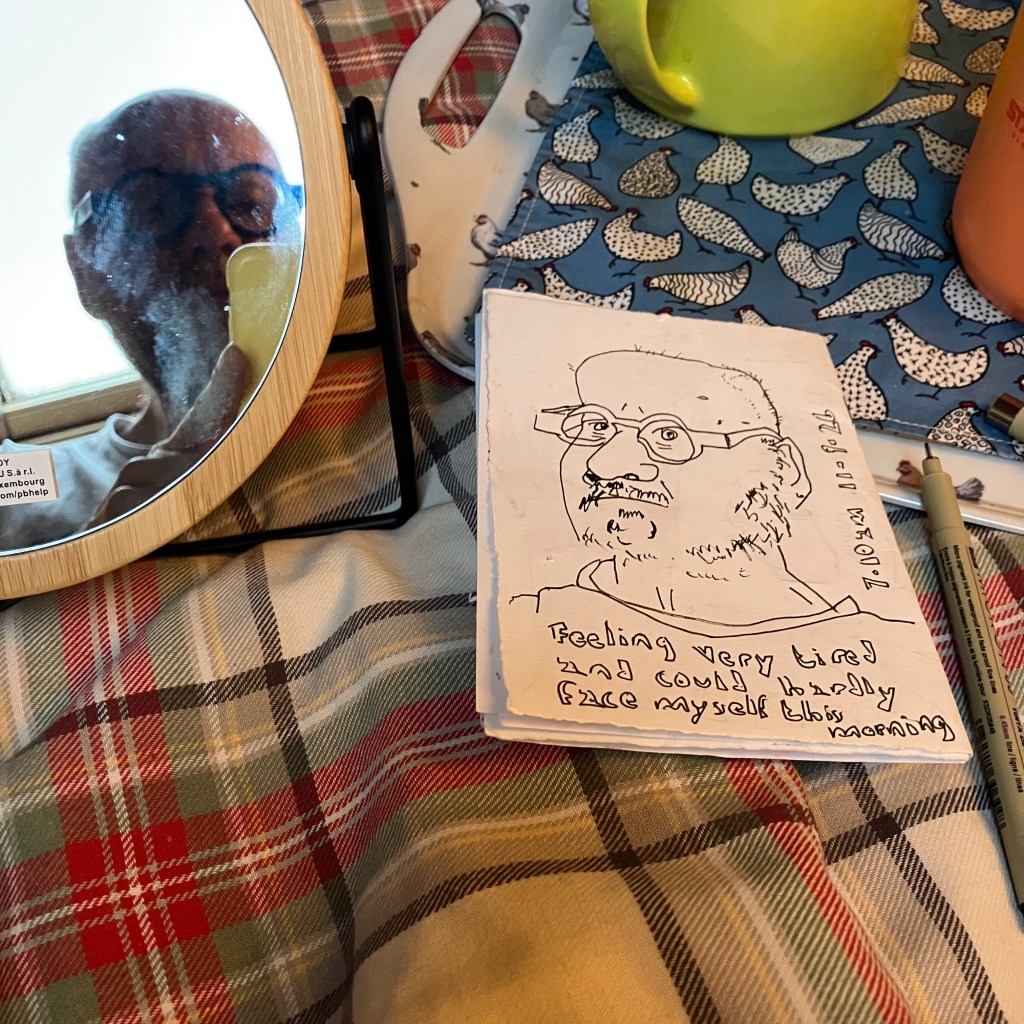
    A wid view of a morning drawing scene on the tartan blanket. On the left, a round wooden-framed mirror reflects Michael’s face and glasses as he looks into it; part of the phone being used to take the photograph obscures the lower centre of his reflection. To the right lies the small handmade sketchbook with the black-ink self-portrait on its back cover and the handwritten words, “Feeling very tired and could hardly face myself this morning.” The date 11-9-26 is written beside the portrait. An uncapped Pigma Micron rests nearby. Behind everything is a tray lined with blue hen-patterned fabric, with a bright green teapot and part of an orange mug visible at the top of the frame.

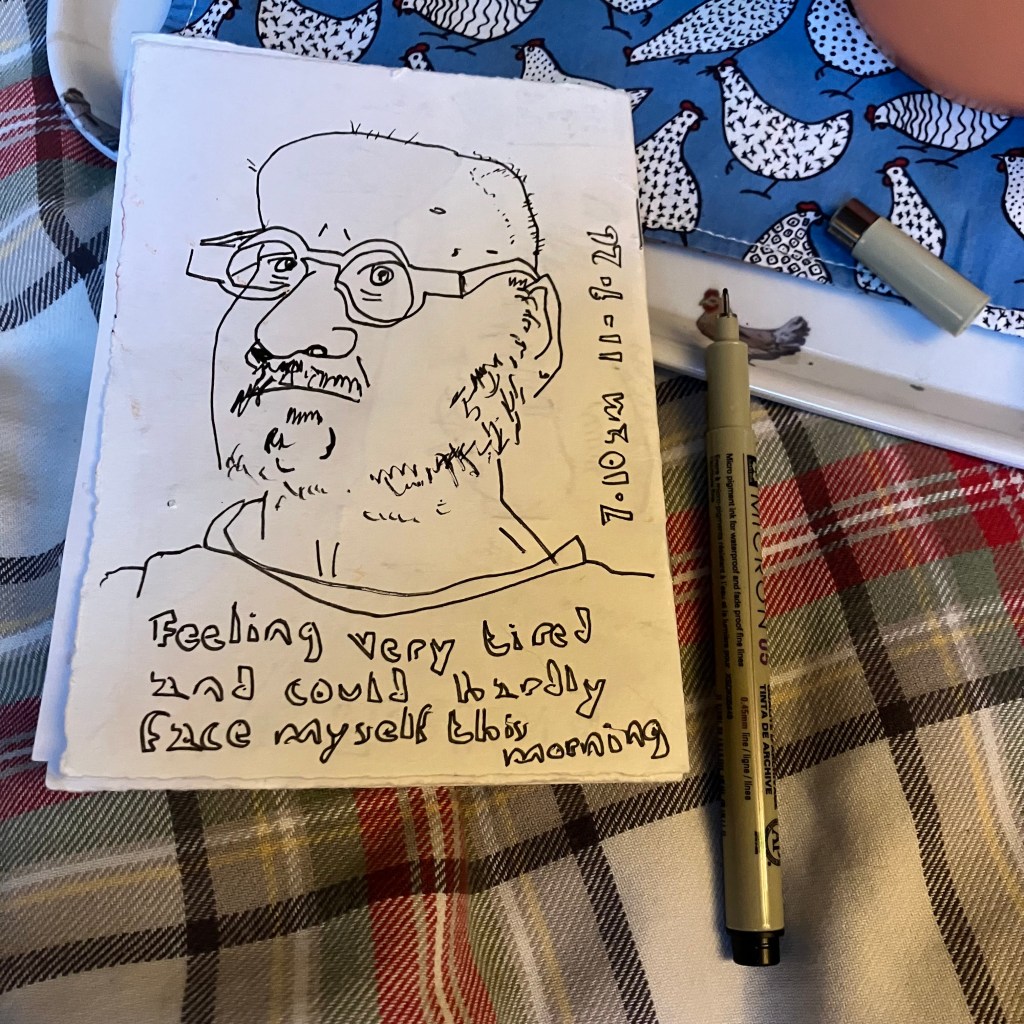
    Very tired this morning and could hardly face myself, but habits can be like being on auto-pilot and, as soon as I poured out my tea, I reached for my mirrors, sketchbook and pen.

    The only place I had to draw to hand was the back cover of my recently filled little homemade pocket sketchbook, so this was a smaller attempt at seeing myself, made with an 05 Pigma Micron — a recent gift from a friend and a pen I haven’t drawn with since I restarted drawing, and possibly not for twenty years.

    Close-up of a small black-ink self-portrait drawn on the back cover of a handmade pocket sketchbook, lying on a red, grey and cream tartan blanket. The drawing shows Michael from the shoulders up, bald, wearing glasses and looking slightly to one side, with short broken lines describing his beard and stubble. Beneath the portrait he has handwritten, “Feeling very tired and could hardly face myself this morning.” The date 11-9-26 is written vertically beside his head. An uncapped beige Pigma Micron pen lies to the right, with its cap above it. Behind the sketchbook is a tray lined with bright blue fabric covered in patterned hens.

  • An emerging 4.00 am drawing habit?

    I seem to be awake at 4.00 am a lot at the moment and have decided, for now, to just go with the flow and draw myself.

    The complete video, in which I leaf through David Hockney’s book Faces 1966–1984, is available over on my Patreon.

  • Finding my way back here

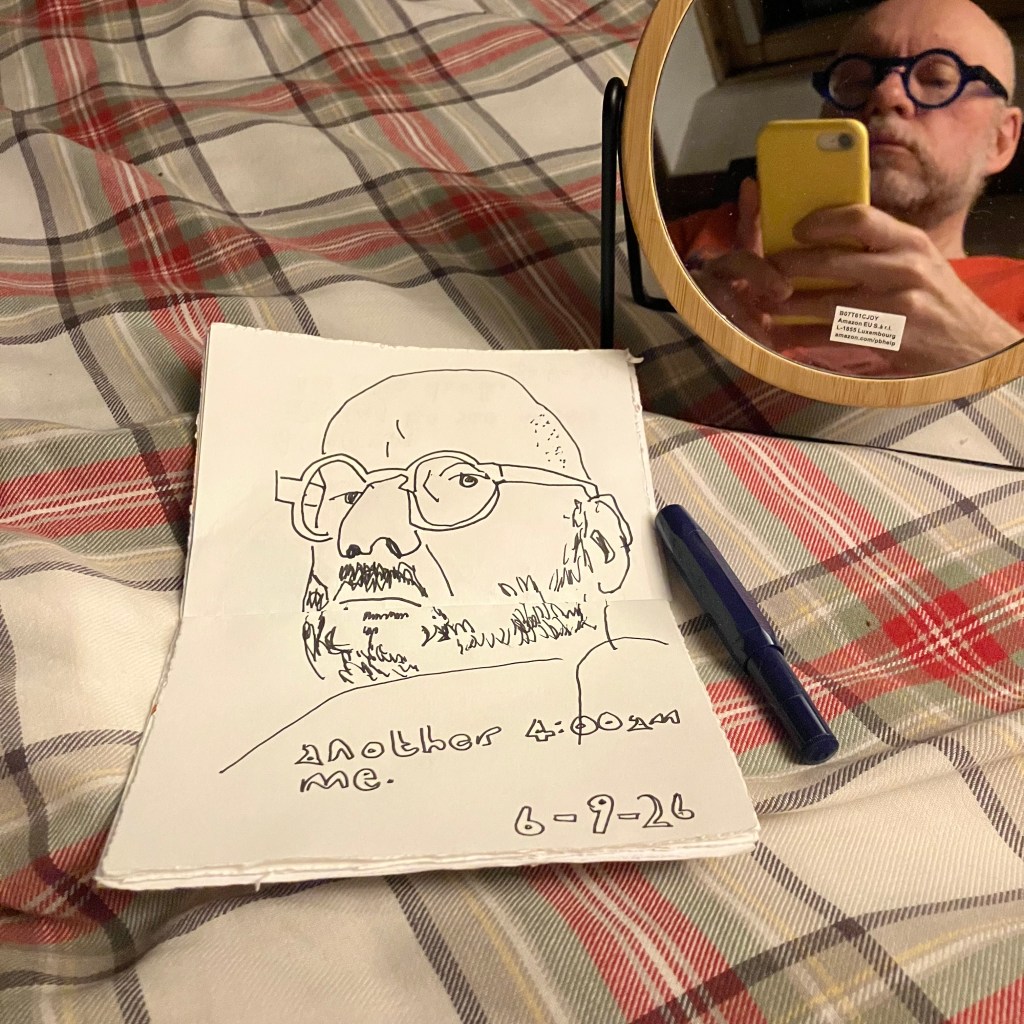
    A black-ink self-portrait drawing lying on a red, grey and cream checked duvet, beside a dark blue fountain pen. At the top right, a round mirror reflects a bald man with round blue glasses holding a yellow phone. The drawing shows the same view, with glasses, beard and moustache, and is handwritten “another 4:00am me. 6-9-26”.

    It’s been quite a while since I last wrote here. I think gaps can say almost as much as what’s actually said, so I’m not going to try to catch up, but rather begin again from where I am today.

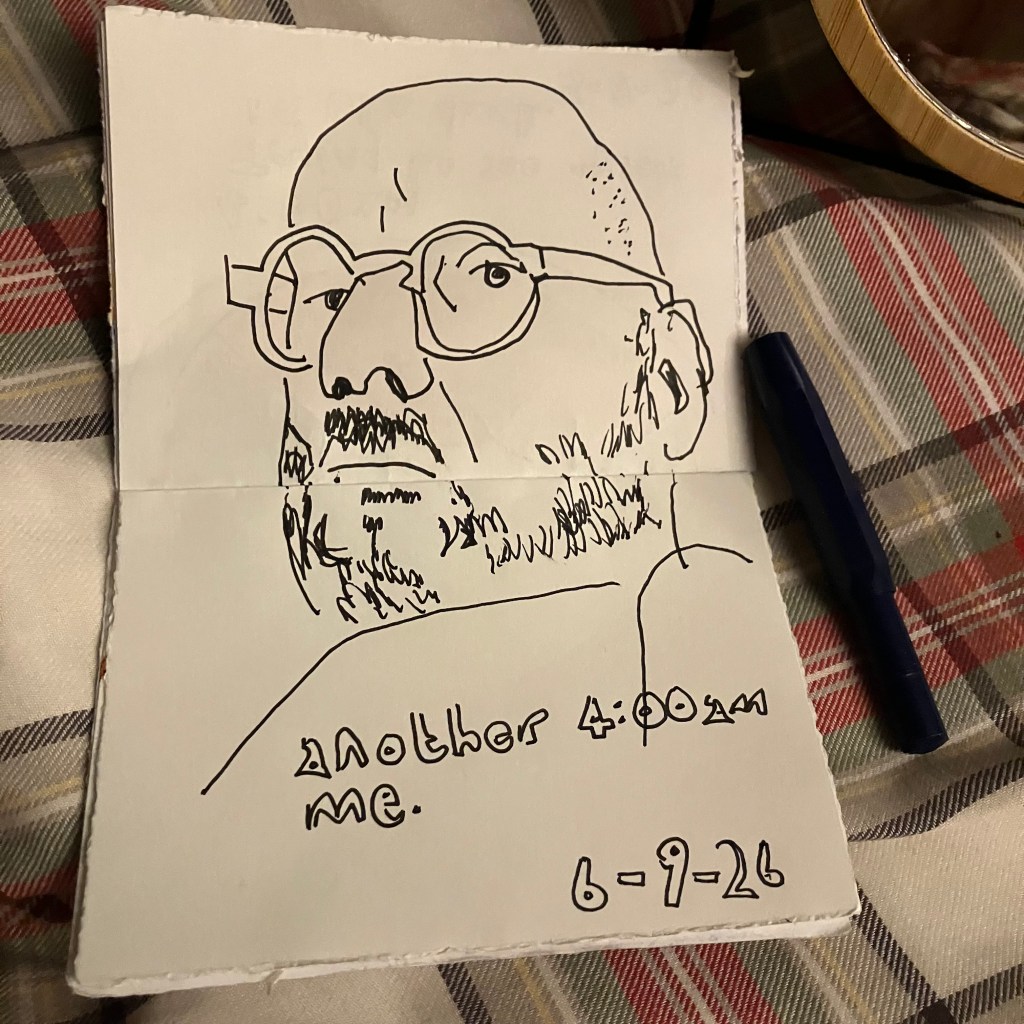
    I’m drawing self-portraits at the moment—joining in with #Selfietember. I’ve bought myself a mirror and have been eyeballing myself in the wee small hours when I haven’t been able to sleep.

    Today felt intimate and uncomfortable. I was very tired, but couldn’t sleep. Wired. I enjoyed making the few marks that made up this drawing.

    Oh, and I’m drawing with a pen these days. My pencil seems to have found its way back into its pencil case—for now, at least.

    Close-up of the black-ink self-portrait on white paper, resting on the checked duvet with a dark blue fountain pen alongside. The loose line drawing shows a bald head, round glasses, beard and moustache, with the words “another 4:00am me. 6-9-26” written underneath.

  • Drawing without firm ground

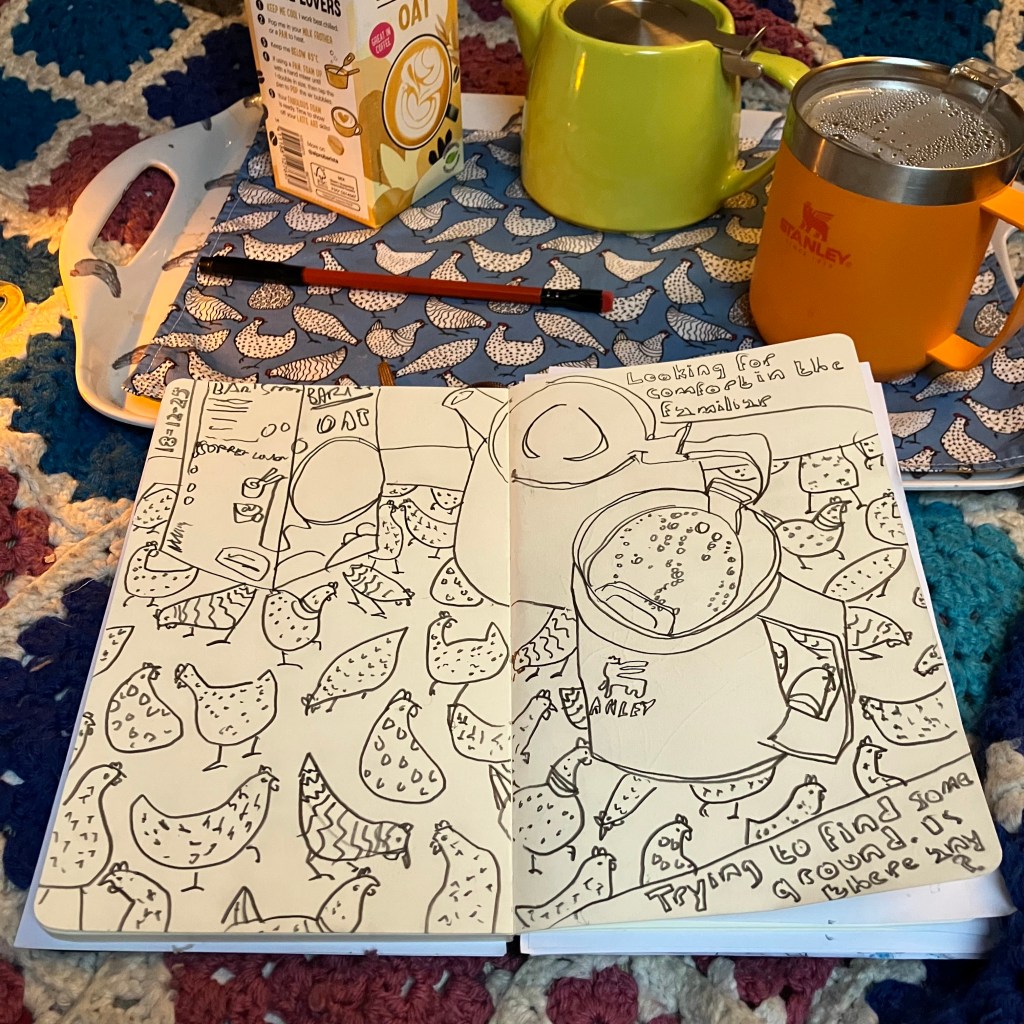
    A sketchbook lies open on a blue patterned tea tray resting on a multicoloured crocheted blanket. The tray is white with cut-out handles and lined with a cloth covered in repeating hen shapes. Beside the sketchbook and on the tray sit a lime-green teapot, an orange insulated Stanley mug with steam condensing under the perspex lid, and a carton of barista oat milk. The drawing across the two sketchbook pages shows the same objects arranged on the tray: the mug in the foreground, the teapot above it, and the oat-milk carton to the left, all outlined in loose pencil lines. The background of the drawing is filled with many small hen motifs, repeating across both pages. Handwritten text within the drawing reads “Looking for comfort in the familiar” and “Trying to find some ground. Is there any?”.

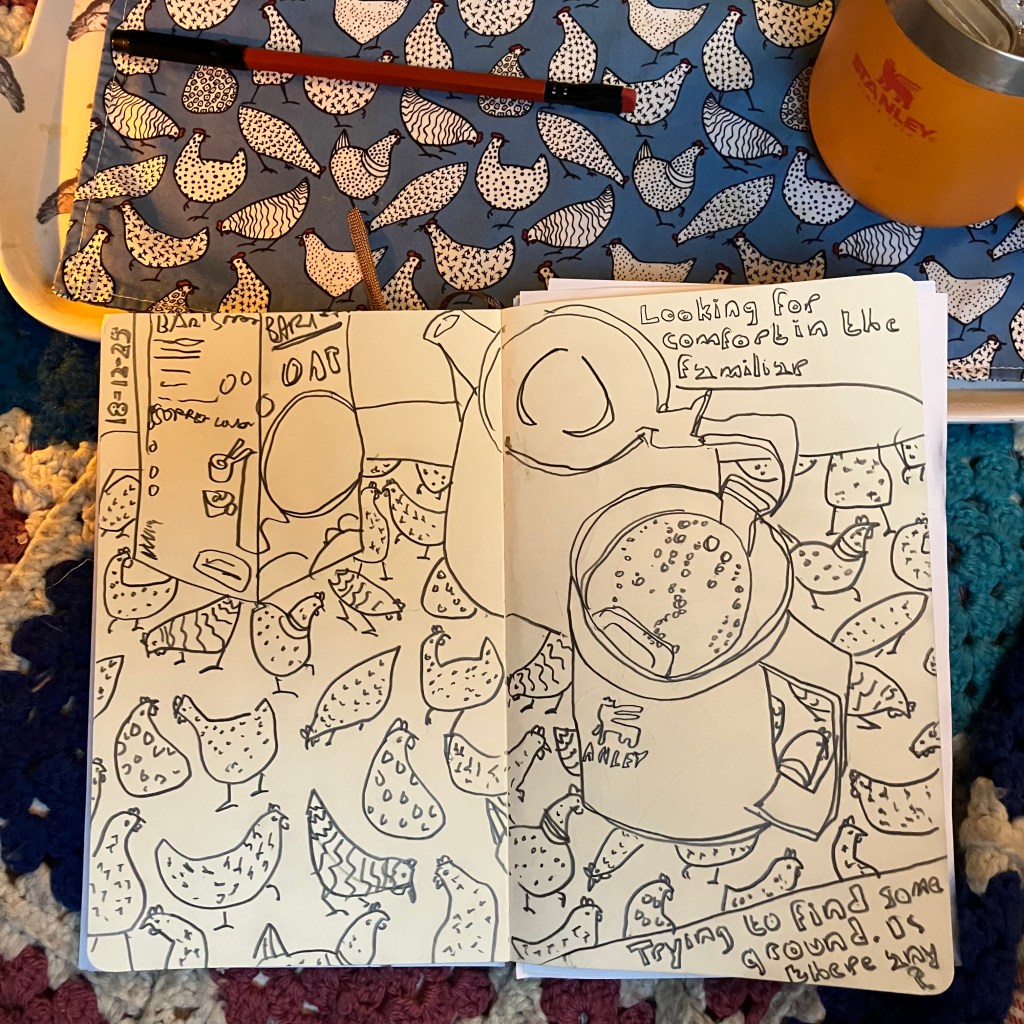
    I made a drawing this morning hoping for a little comfort. I drew the objects I know: mug, teapot, oat milk, tray. Familiar companions to steady anxious hands.

    As I worked, I found myself thinking about “firm ground” — the feeling of being steadied by something reliable. I’d hoped the drawing might give me that today. But as the lines unfolded, I realised that hunting for ground might be what pulls me off balance in the first place.

    Maybe there isn’t firm ground in the way I keep wanting it. Maybe drawing is simply a way of staying with that uncertainty for a few minutes at a time — accepting the unsteady surface, line by line, rather than trying to find something solid underneath.

    A note to self: perhaps comfort can come from letting go of the search.

    A closer view of the open sketchbook resting on a blue hen-patterned tray cloth. Only the drawing and a small portion of the white tray edge are visible. The two-page spread shows loose pencil outlines of a lime-green teapot, an orange insulated Stanley mug, and a barista oat-milk carton arranged across the tray. The pages are densely filled with repeated hen motifs drawn beneath and around the objects. Handwritten phrases inside the drawing read “Looking for comfort in the familiar” near the top edge and “Trying to find some ground. Is there any?” along the lower right corner.
  • Dealing With Last Page / First Page Anxiety

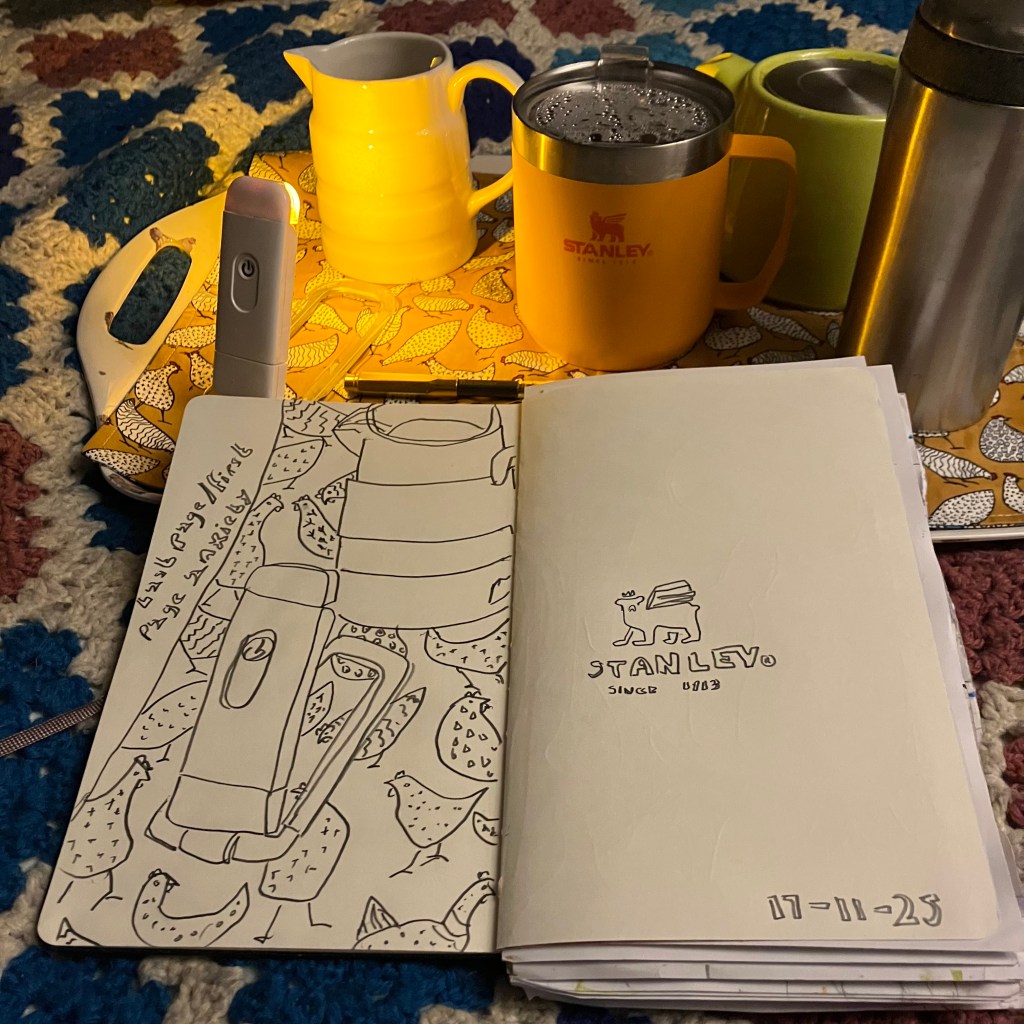
    A view of a tea tray arranged on a bed covered with a crocheted blanket. On the tray is a patterned hen tray mat, and resting on the mat are a white milk jug, an orange insulated mug, a tall stainless-steel flask, a lime-green teapot, and a slim reading light rising just behind them. In front of the tray lies an open sketchbook. **On its left page is a dense pencil drawing of some of the items from the tray — the reading light and the milk jug — shown sitting on the hen-patterned mat.** On its right page, centred within a large area of blank paper, is a small hand-drawn version of the Stanley logo — a winged bear wearing a crown — with “STANLEY. Since 1913” written beneath it. Warm lamplight falls across the scene.

    This morning I woke with a tightness around the idea of making my morning drawing — a physical resistance to picking up my sketchbook. I’ve been working backwards through this sketchbook, so although I’d reached what was, for me, the final blank spread, it was also the first pair of pages after opening the cover. I’d been feeling it coming for days and, unusually, it had been haunting me.

    I’ve been working this way through sketchbooks for more than two and a half years — since I first returned to drawing after Mary Gordon died. It was a strategy born out of needing to avoid the paralysing pressure of a perfect first page. At first I simply chose random places to draw, but soon I settled into working from back to front. It has served me well, but with this sketchbook that first-page paralysis has reared its head again — maybe because of the recent stress around my health and all the newness.

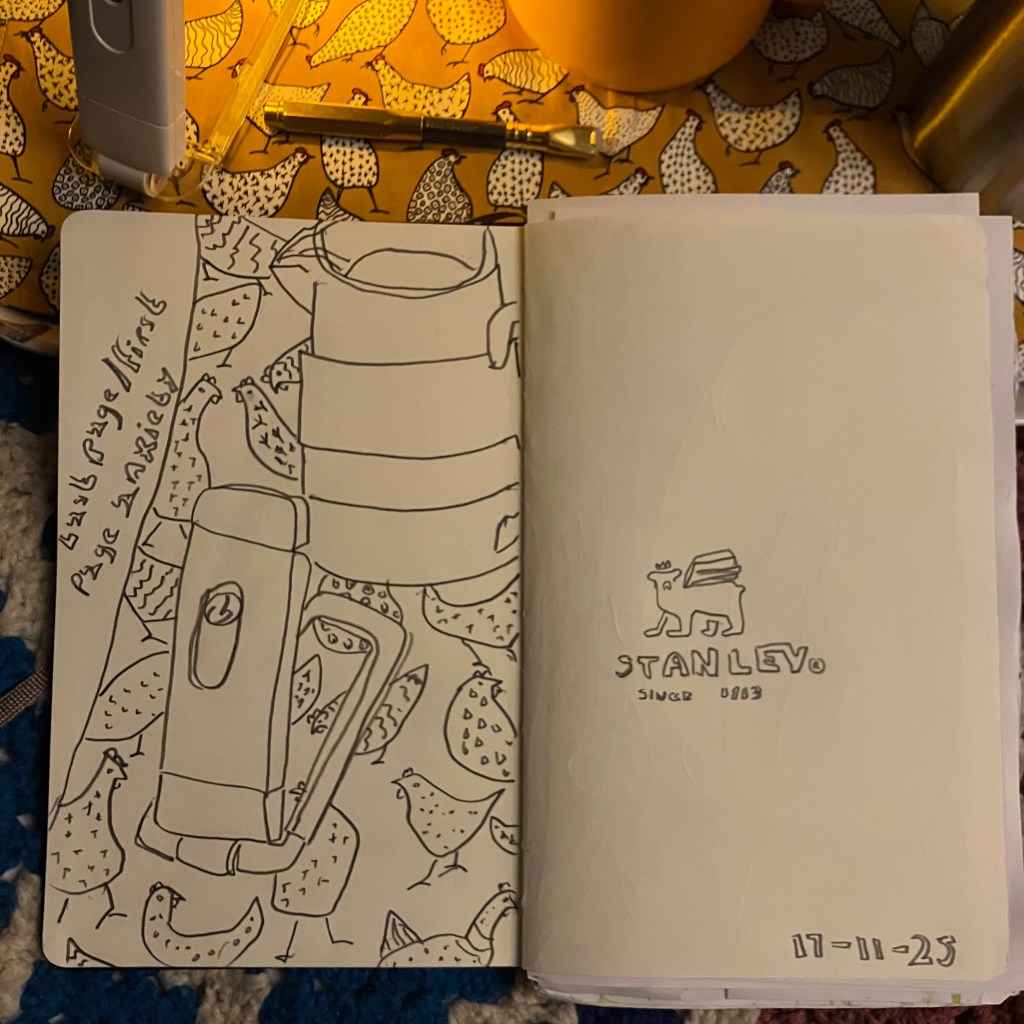
    Interestingly, in worrying about meeting this page, I’d forgotten about the power of routine. Simply making my tea, arranging my tea-things on the tray, and bringing it back to bed found me reaching for my sketchbook and pencil and beginning to draw. I stayed gentle and started with something small and contained: the Stanley logo on my insulated mug. I’ve been wanting to draw it for a while, and its sparseness felt like the right entry point. Once that was on the page, the drawing grew easily — the reading light, the illustrated hen mat, the milk jug. Familiar shapes. Familiar company.

    I decided not to add any colour, and as I dated the drawing to mark it as finished, I felt a quiet satisfaction at having made it through that moment of resistance — and at having filled another sketchbook, one drawing at a time, from back to front.
    A close-up view of an open sketchbook resting on a bed. On the left page is a dense line drawing made with pencil showing a reading light and a milk jug, both sitting on a patterned hen tray mat. The hens form a repeating background across the whole page. On the right page, centred within a large area of blank paper, is a small hand-drawn version of the Stanley logo — a winged bear wearing a crown — with “STANLEY. Since 1913” written beneath it. The date “17–11–25” appears in the lower corner. 

Above the sketchbook the edges of the tray from the drawing can be seen showing the base of the reading lamp and part of the hen patterned tray mat from the drawing, along with a short pencil with a gold point guard and what looks like the base of an orange mug and a silver flask. Warm lamplight softens the edges of the paper.