Tag: painting

  • Drawing Mary (upside down)

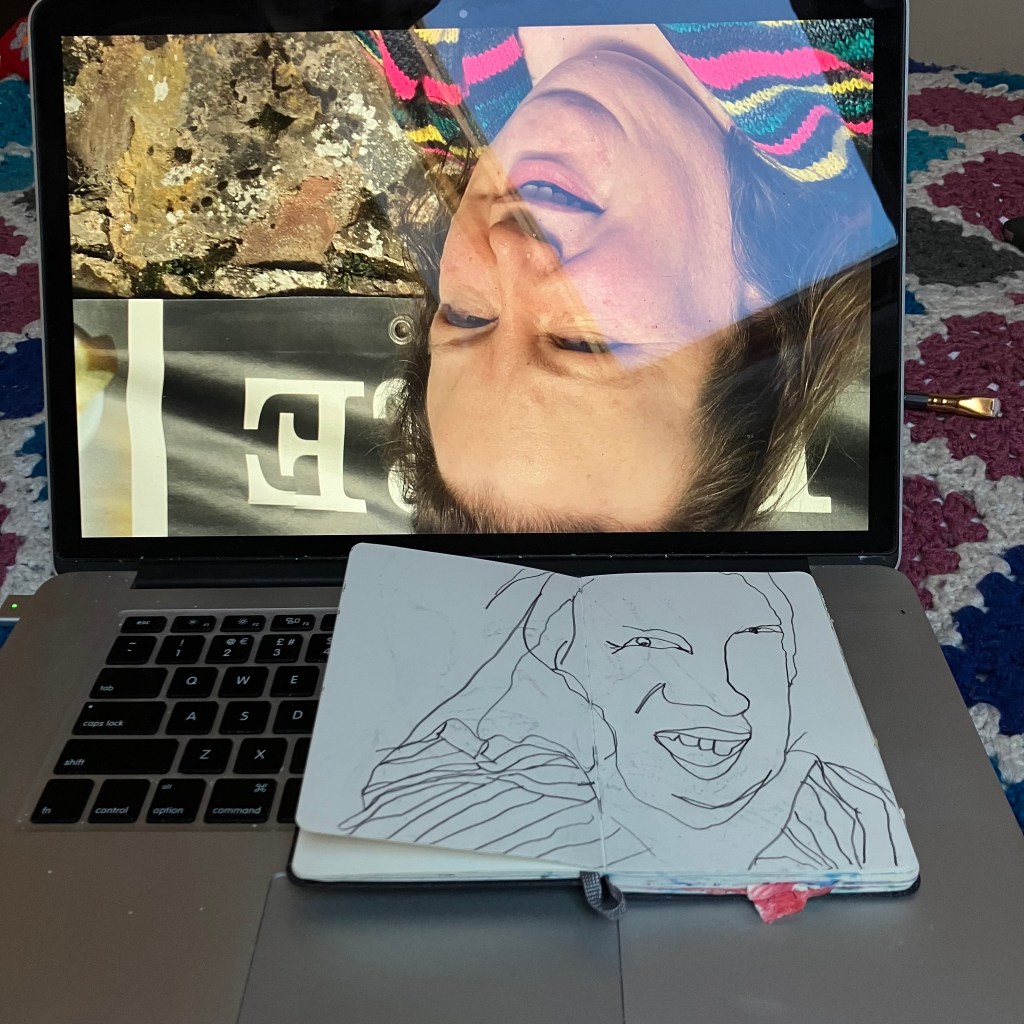
    A laptop resting on a crocheted blanket, showing an upside-down photograph of a woman outdoors, against a stone wall, wearing a striped jumper in bright colours. In front, a small open sketchbook lies on the keyboard, displaying a loose line drawing of the same face. A pencil rests nearby.

    A beginning — or a returning

    This feels like an important drawing — the first I’d made in nearly ten years after suddenly stopping drawing in 2013. It’s of my dear friend Mary, who had just died.

    Hearing the news — and knowing I needed to draw

    In my grief after hearing she had died, I was sent into quite a spin about my own mortality, and I realised with a sudden shock that I didn’t want to die myself without drawing again. I went into town looking for the familiar — the pocket-sized Moleskine sketchbook I used to draw in many years ago — but I couldn’t find one.

    I ended up ordering one from Amazon that same afternoon.

    The invoice — and what it showed me later

    I’ve just found the invoice — dated 10th March 2023 — the very day I received the message telling me she’d gone. That was how urgent getting hold of that familiar sketchbook, and making a drawing in it, must have felt.

    According to the invoice, it arrived the next day — so this drawing could have been made on or around the 11th of March 2023.

    Why upside down?

    It is an upside-down drawing, following an exercise from Betty Edwards’ excellent Drawing on the Right Side of the Brain. The exercise — turning a photograph upside down to draw from, so the brain is tricked into really looking at what’s there — felt like a gentle way back into drawing after so many years.

    Looking back, I think I also needed Mary herself to be upside down so I wasn’t looking directly at my lovely, now dead, friend. That slight detachment helped me see only shapes and lines, rather than the full weight of grief.

    A drawing that felt like me

    Unlike most of the rest of that sketchbook, this drawing looks more like the drawings I’m making today (and the ones I was making back in 2013). The marks feel very me — in their quickness and weight. Most of the other drawings feel nervous and uncertain. This one, though — this one feels like me finding myself again.

    Why it mattered — then and now

    The drawing mattered then because it was proof that I could still make a line. That drawing itself was something I hadn’t lost — not completely. It mattered because it was a beginning — or maybe more accurately, a returning — even though I didn’t, or couldn’t, trust that at the time.

    It matters today because I can see what I couldn’t quite see then: this drawing quietly held both loss and return. It was an opening — quiet, unannounced, and upside down. A small act of mark-making that allowed all the others to follow.

    See also: Finding out that Mary Gordon had died and Moleskine Invoice
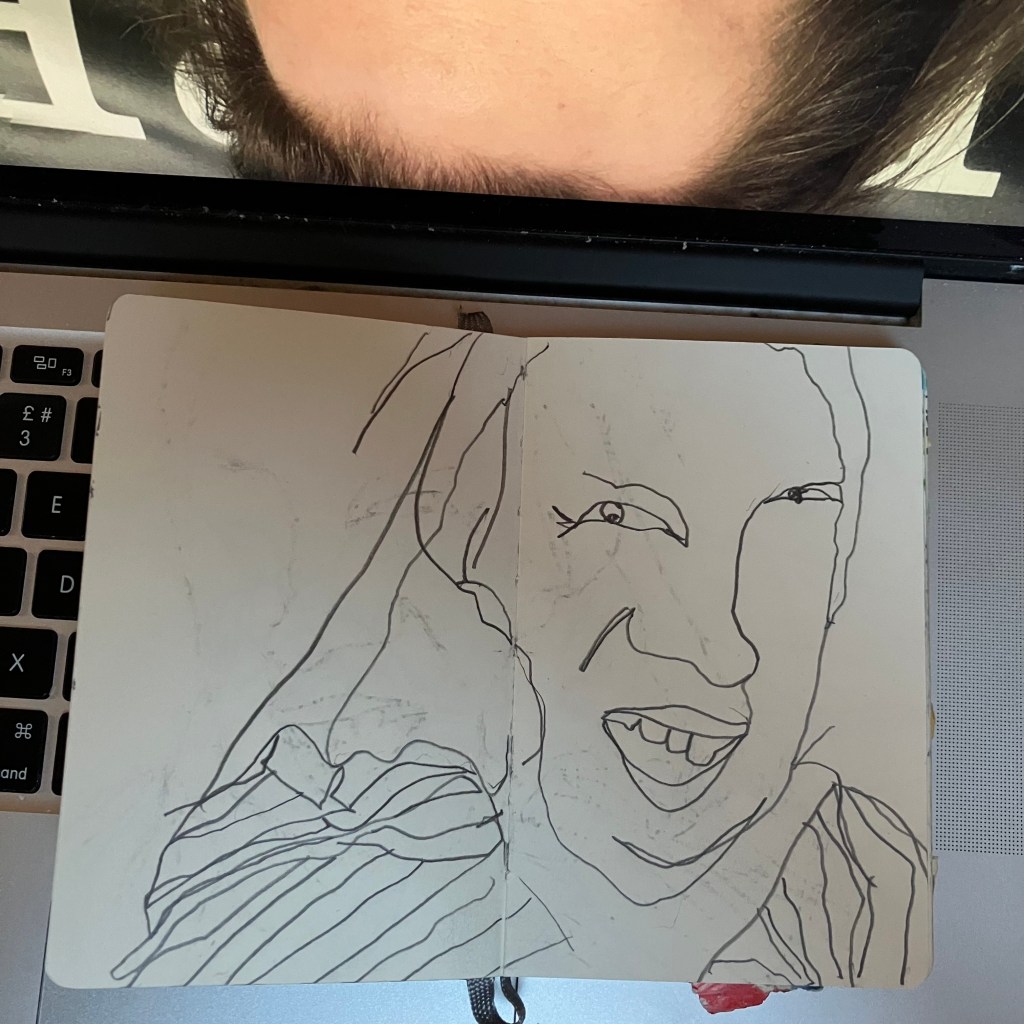
    A small open sketchbook lies on the keyboard of a laptop. On the laptop screen, an upside-down photograph shows part of a woman’s forehead and hair. The sketchbook page contains a loose line drawing of a face, with bold outlines defining the eyes, mouth, and clothing folds. The surrounding area is softly lit and uncluttered.
  • Dealing With Last Page / First Page Anxiety

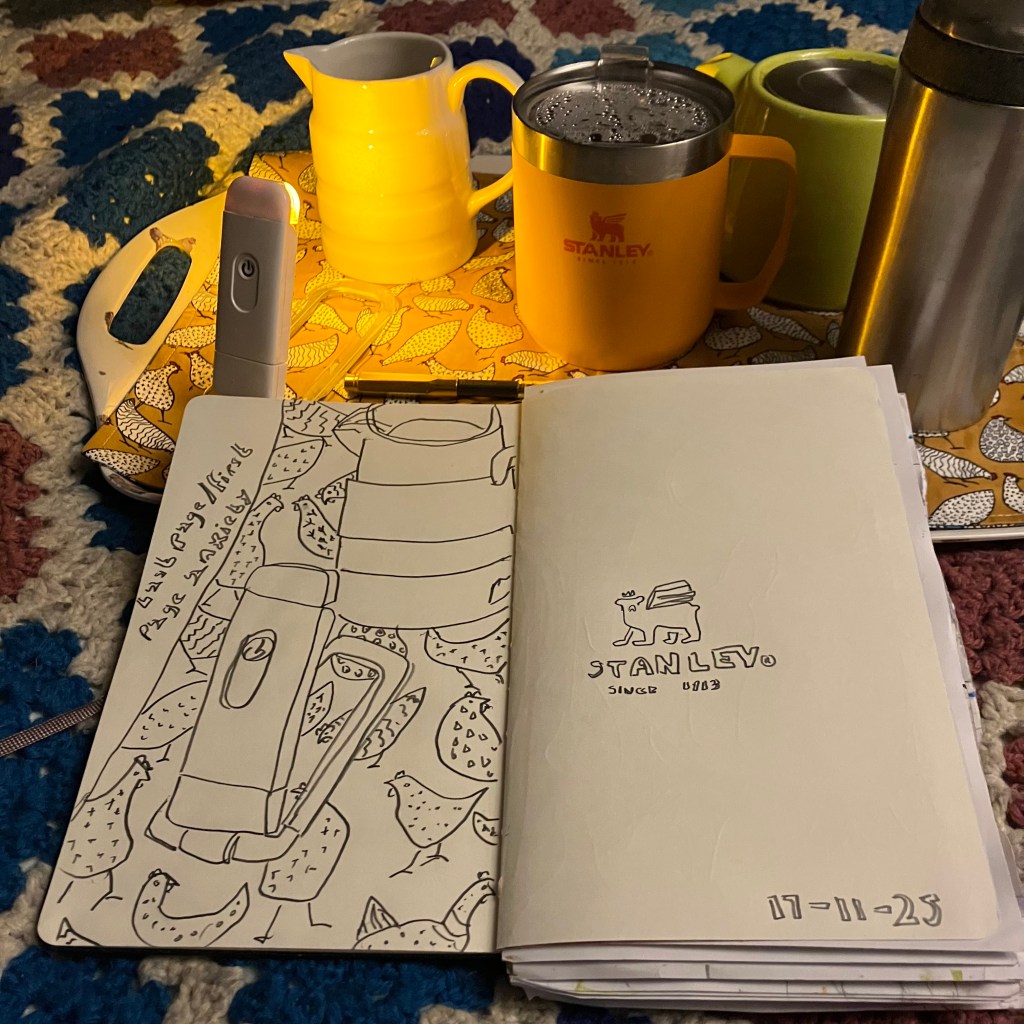
    A view of a tea tray arranged on a bed covered with a crocheted blanket. On the tray is a patterned hen tray mat, and resting on the mat are a white milk jug, an orange insulated mug, a tall stainless-steel flask, a lime-green teapot, and a slim reading light rising just behind them. In front of the tray lies an open sketchbook. **On its left page is a dense pencil drawing of some of the items from the tray — the reading light and the milk jug — shown sitting on the hen-patterned mat.** On its right page, centred within a large area of blank paper, is a small hand-drawn version of the Stanley logo — a winged bear wearing a crown — with “STANLEY. Since 1913” written beneath it. Warm lamplight falls across the scene.

    This morning I woke with a tightness around the idea of making my morning drawing — a physical resistance to picking up my sketchbook. I’ve been working backwards through this sketchbook, so although I’d reached what was, for me, the final blank spread, it was also the first pair of pages after opening the cover. I’d been feeling it coming for days and, unusually, it had been haunting me.

    I’ve been working this way through sketchbooks for more than two and a half years — since I first returned to drawing after Mary Gordon died. It was a strategy born out of needing to avoid the paralysing pressure of a perfect first page. At first I simply chose random places to draw, but soon I settled into working from back to front. It has served me well, but with this sketchbook that first-page paralysis has reared its head again — maybe because of the recent stress around my health and all the newness.

    Interestingly, in worrying about meeting this page, I’d forgotten about the power of routine. Simply making my tea, arranging my tea-things on the tray, and bringing it back to bed found me reaching for my sketchbook and pencil and beginning to draw. I stayed gentle and started with something small and contained: the Stanley logo on my insulated mug. I’ve been wanting to draw it for a while, and its sparseness felt like the right entry point. Once that was on the page, the drawing grew easily — the reading light, the illustrated hen mat, the milk jug. Familiar shapes. Familiar company.

    I decided not to add any colour, and as I dated the drawing to mark it as finished, I felt a quiet satisfaction at having made it through that moment of resistance — and at having filled another sketchbook, one drawing at a time, from back to front.

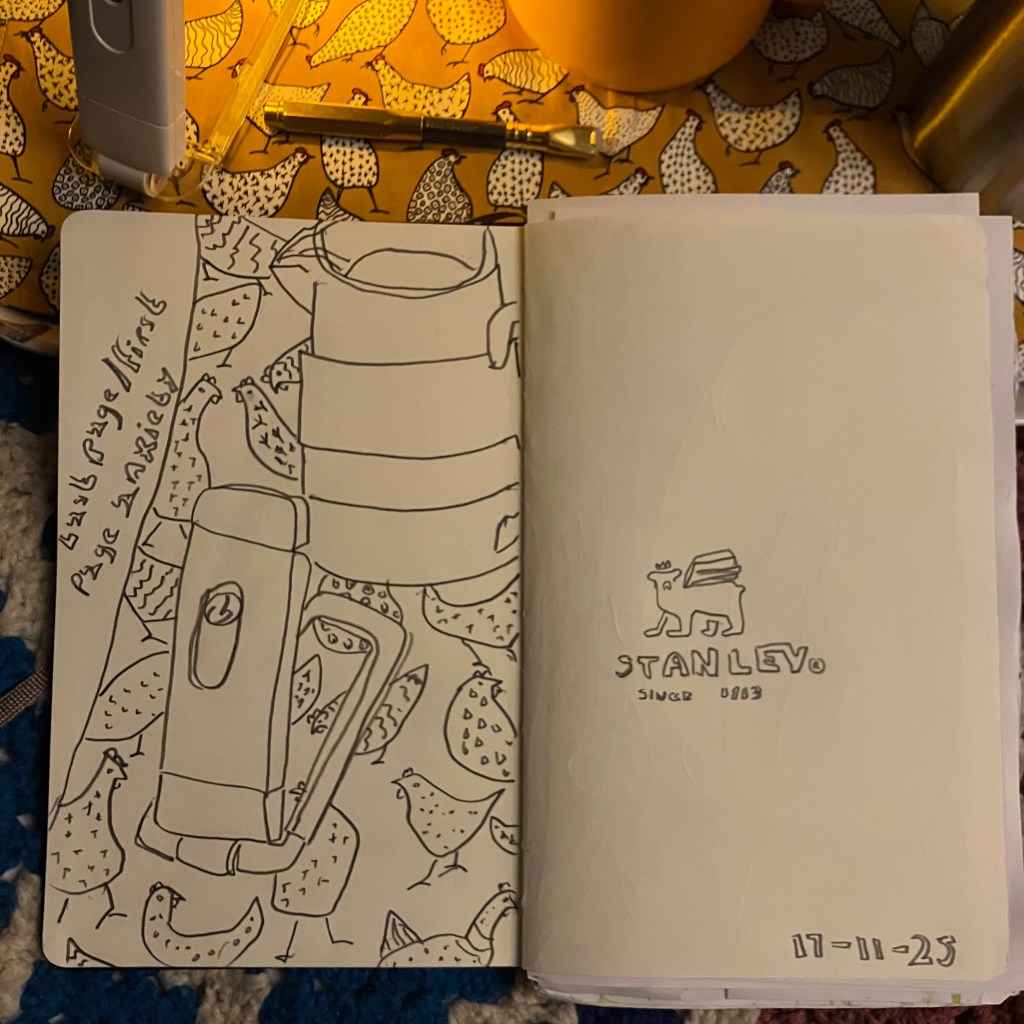
    A close-up view of an open sketchbook resting on a bed. On the left page is a dense line drawing made with pencil showing a reading light and a milk jug, both sitting on a patterned hen tray mat. The hens form a repeating background across the whole page. On the right page, centred within a large area of blank paper, is a small hand-drawn version of the Stanley logo — a winged bear wearing a crown — with “STANLEY. Since 1913” written beneath it. The date “17–11–25” appears in the lower corner. 

Above the sketchbook the edges of the tray from the drawing can be seen showing the base of the reading lamp and part of the hen patterned tray mat from the drawing, along with a short pencil with a gold point guard and what looks like the base of an orange mug and a silver flask. Warm lamplight softens the edges of the paper.