Tea-tray drawings are a recurring part of my drawing practice — small, everyday observations made while I sit with my tea, usually from the familiar collection of objects gathered around me. Over time they have become a kind of visual diary, recording ordinary mornings, changing materials, and small shifts in how I look at and draw the world close at hand.
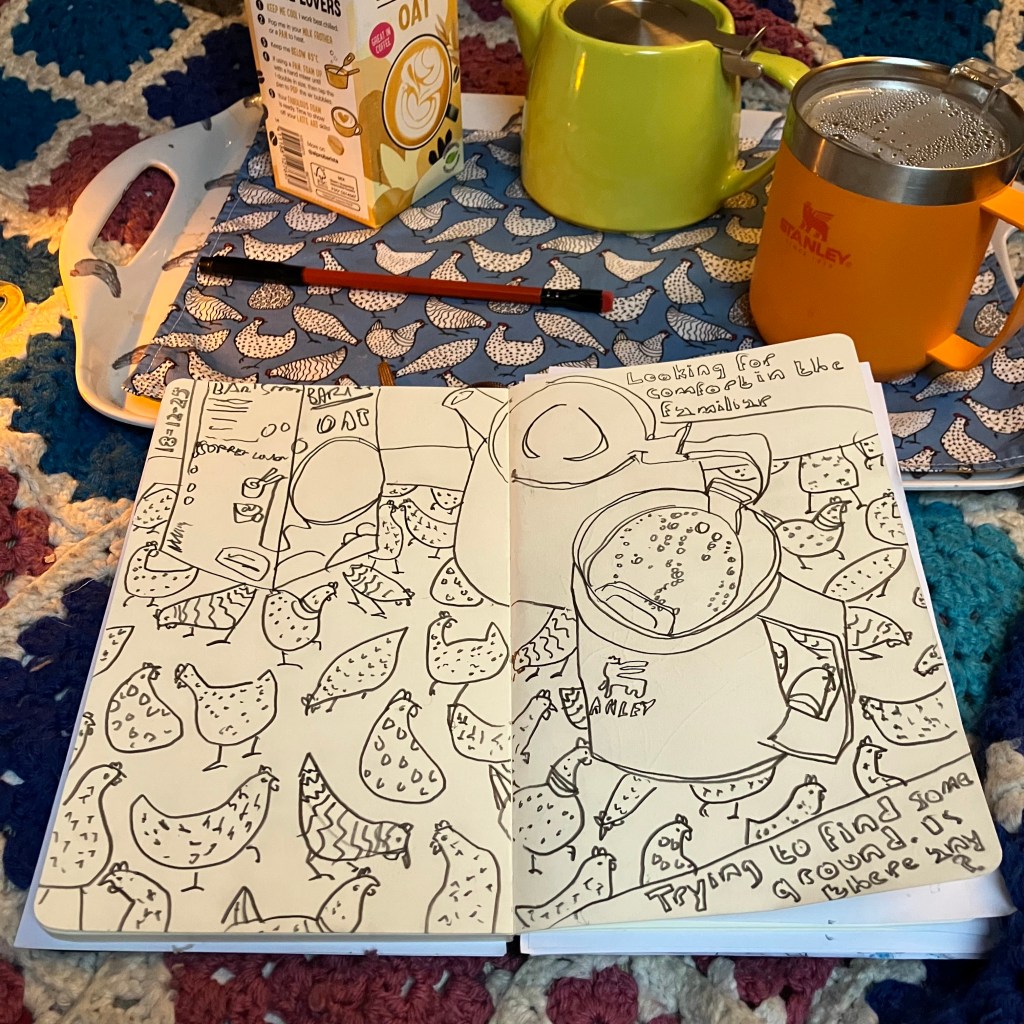
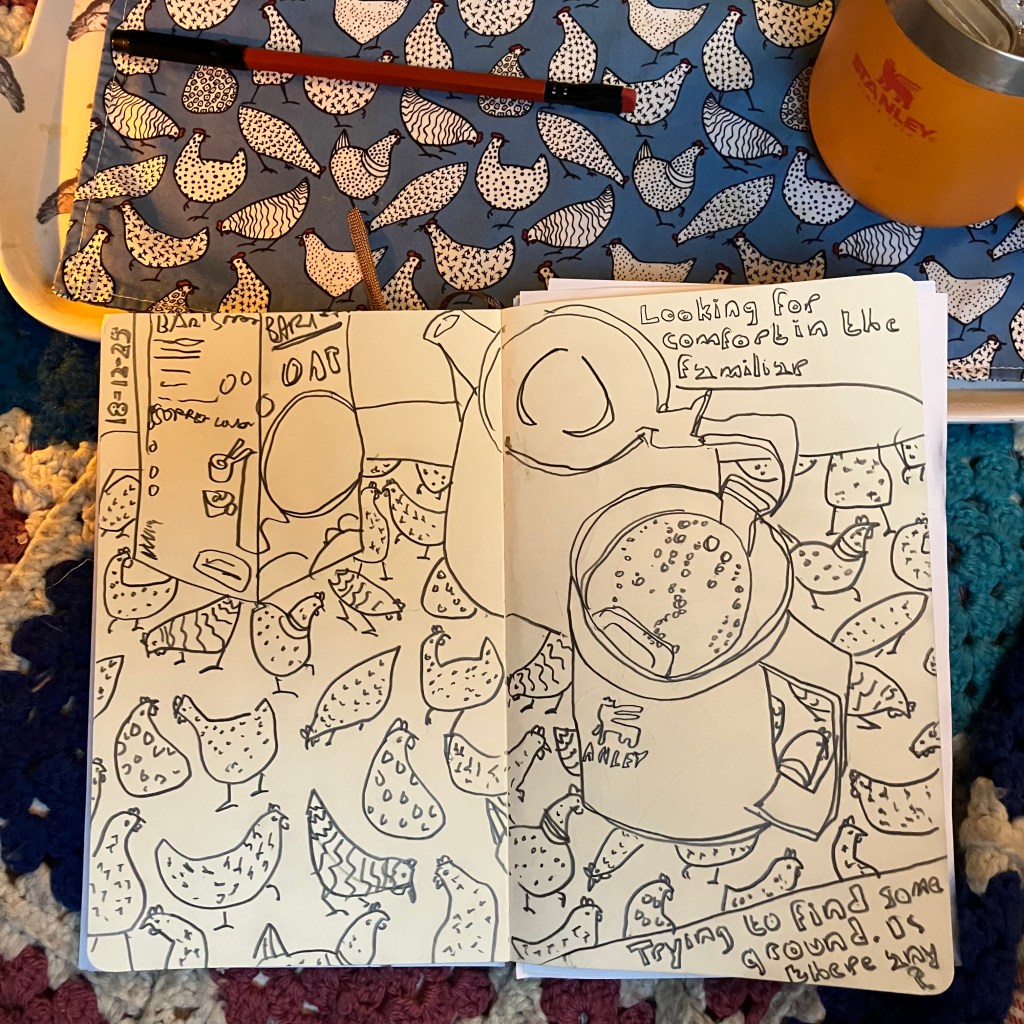
I made a drawing this morning hoping for a little comfort. I drew the objects I know: mug, teapot, oat milk, tray. Familiar companions to steady anxious hands.
As I worked, I found myself thinking about “firm ground” — the feeling of being steadied by something reliable. I’d hoped the drawing might give me that today. But as the lines unfolded, I realised that hunting for ground might be what pulls me off balance in the first place.
Maybe there isn’t firm ground in the way I keep wanting it. Maybe drawing is simply a way of staying with that uncertainty for a few minutes at a time — accepting the unsteady surface, line by line, rather than trying to find something solid underneath.
A note to self: perhaps comfort can come from letting go of the search.
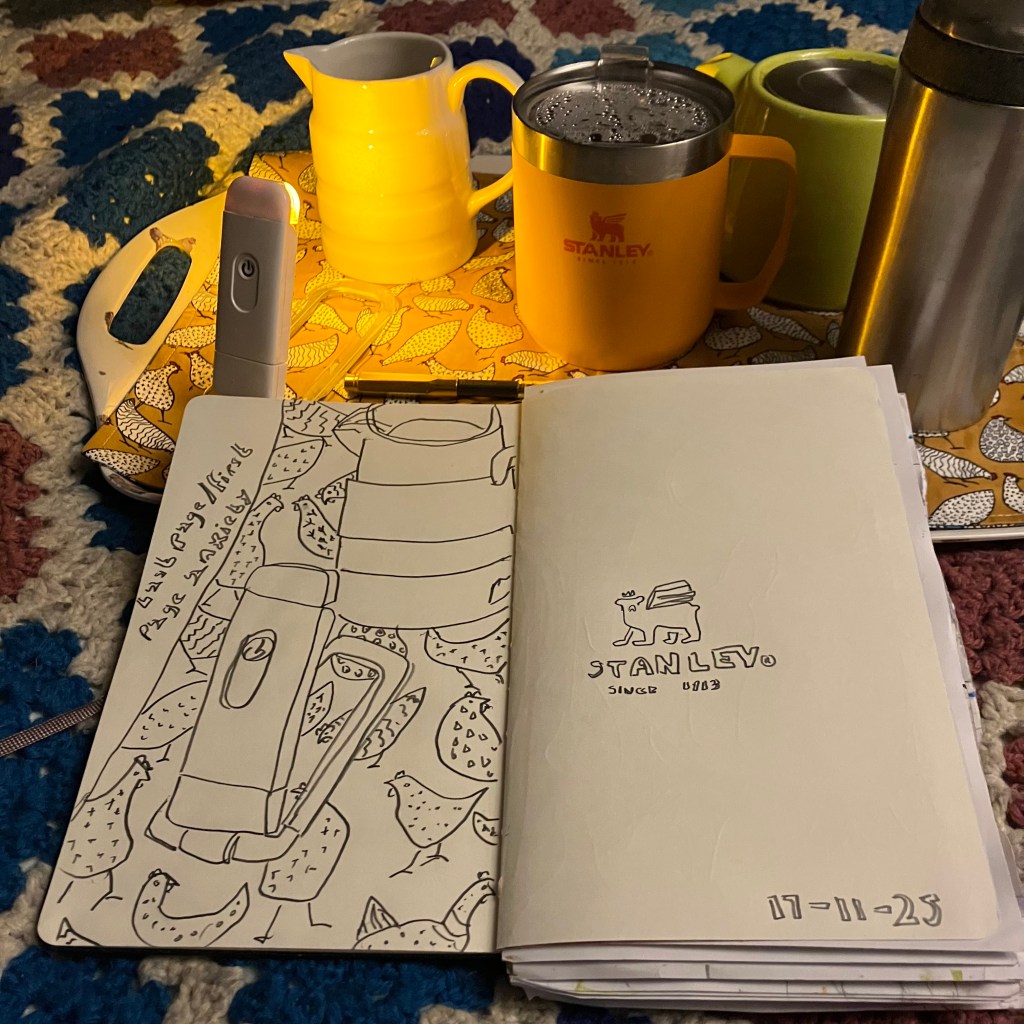
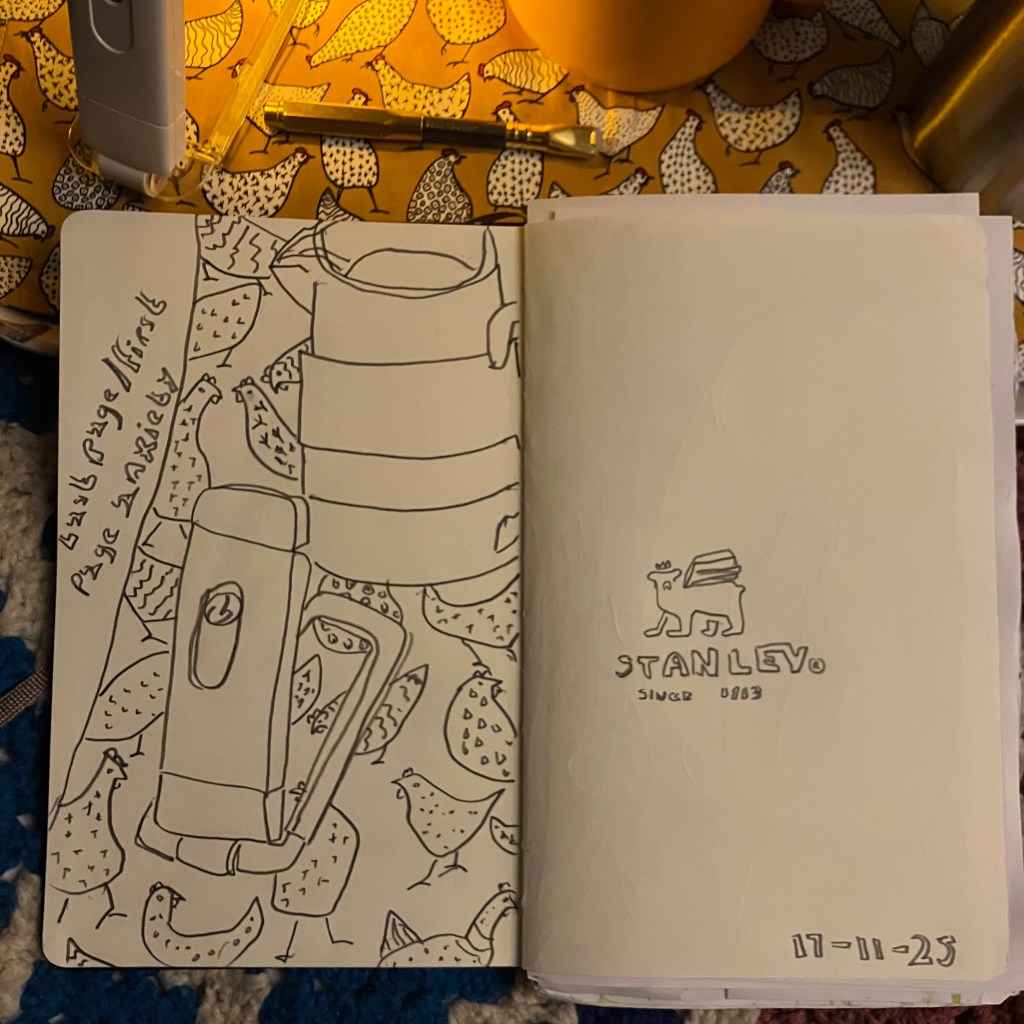
This morning I woke with a tightness around the idea of making my morning drawing — a physical resistance to picking up my sketchbook. I’ve been working backwards through this sketchbook, so although I’d reached what was, for me, the final blank spread, it was also the first pair of pages after opening the cover. I’d been feeling it coming for days and, unusually, it had been haunting me.
I’ve been working this way through sketchbooks for more than two and a half years — since I first returned to drawing after Mary Gordon died. It was a strategy born out of needing to avoid the paralysing pressure of a perfect first page. At first I simply chose random places to draw, but soon I settled into working from back to front. It has served me well, but with this sketchbook that first-page paralysis has reared its head again — maybe because of the recent stress around my health and all the newness.
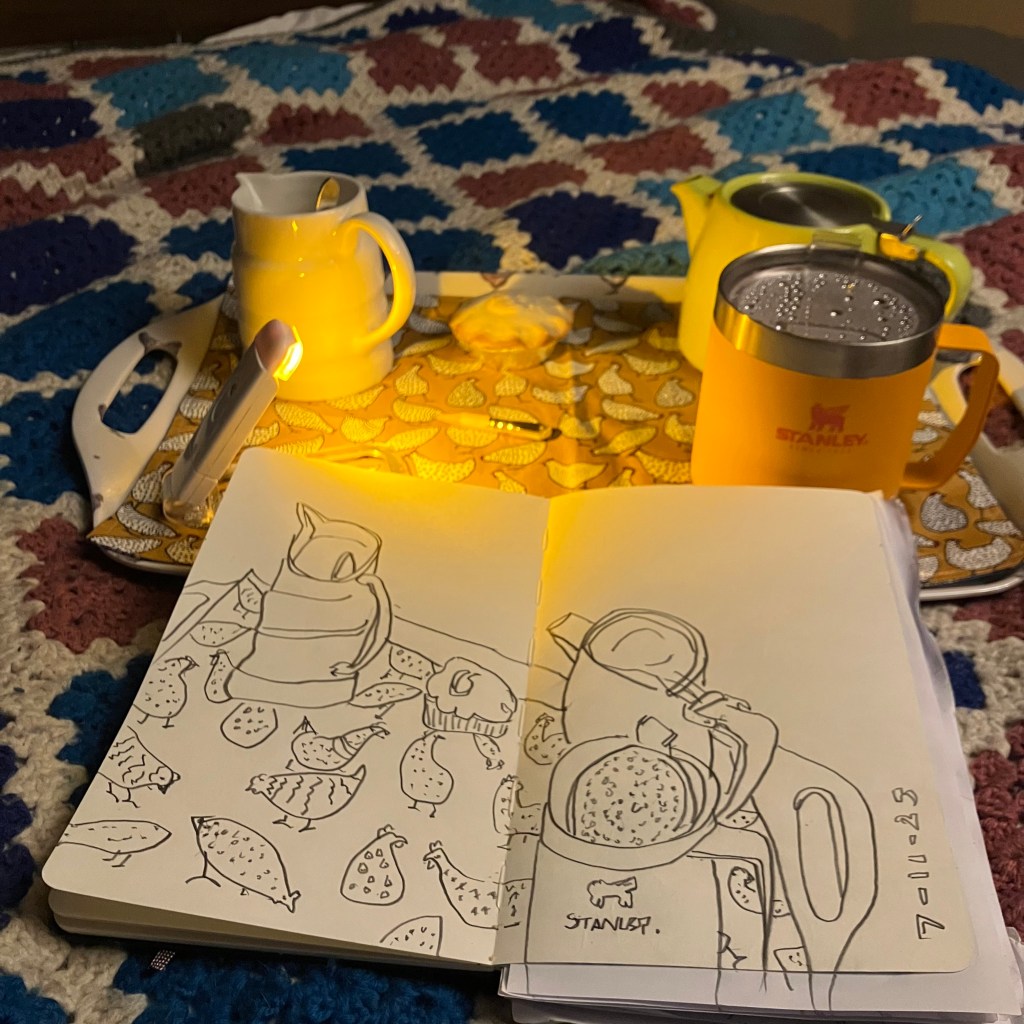
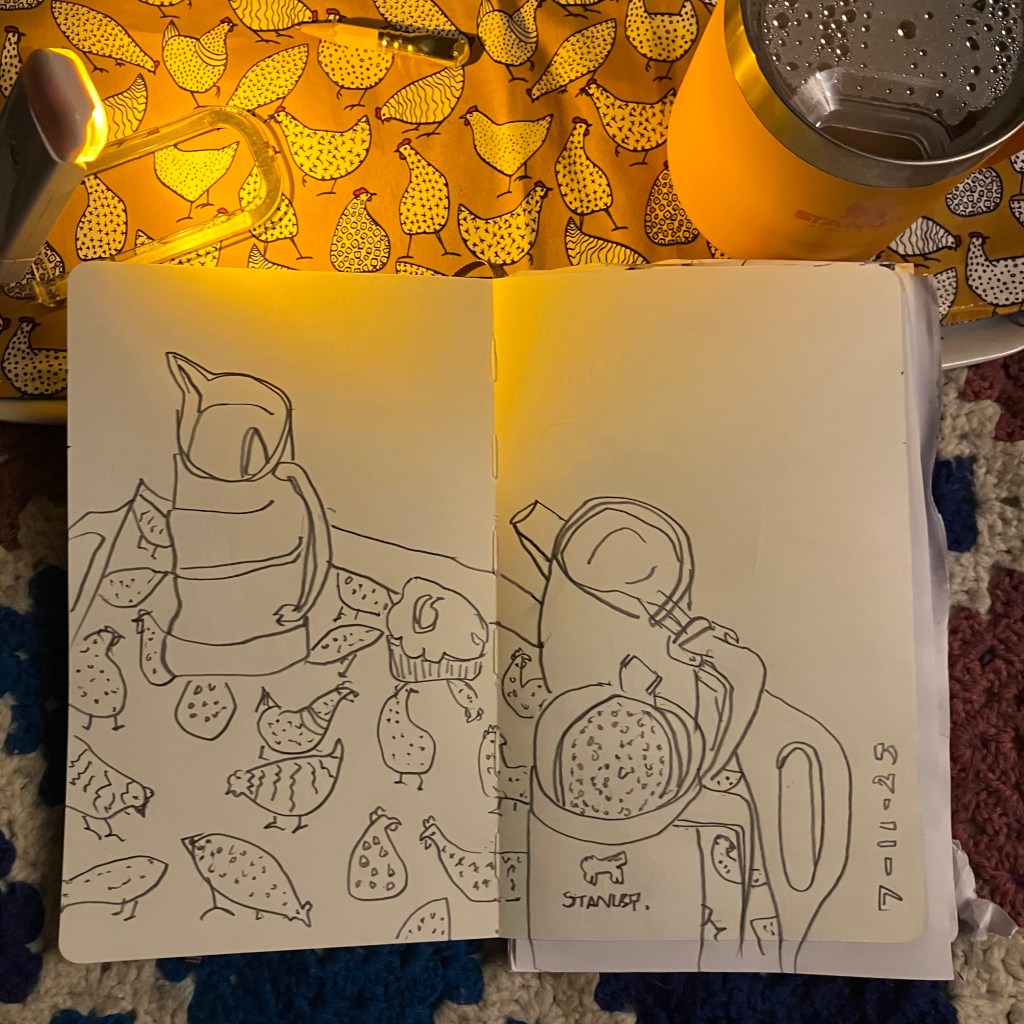
Interestingly, in worrying about meeting this page, I’d forgotten about the power of routine. Simply making my tea, arranging my tea-things on the tray, and bringing it back to bed found me reaching for my sketchbook and pencil and beginning to draw. I stayed gentle and started with something small and contained: the Stanley logo on my insulated mug. I’ve been wanting to draw it for a while, and its sparseness felt like the right entry point. Once that was on the page, the drawing grew easily — the reading light, the illustrated hen mat, the milk jug. Familiar shapes. Familiar company.
I decided not to add any colour, and as I dated the drawing to mark it as finished, I felt a quiet satisfaction at having made it through that moment of resistance — and at having filled another sketchbook, one drawing at a time, from back to front.
Today I turned my new tea-tray mat over, revealing a calm brown background. I also added a Mr Kipling apple pie to my tray — something with warm associations from long ago. Together these two small changes helped me into a calmer space before I started drawing than I was in yesterday.
I began the drawing with the spout of my milk jug. I get pleasure and comfort from drawing its shape — the same is true of my teapot spout. After drawing both, I moved on to my new insulated mug, starting with the little sticking-out piece of its lid. I can see that this might become a familiar starting point — it isn’t yet, but the possibility that it might pleases me.
I made the decision to include the chickens on the tray mat — more unfamiliarity — but then I spotted a chicken that was familiar. It is the same as the one on my lesser-used (but still often drawn) Go Gently George mug. Seeing that one helped the other illustrated chickens feel friendlier. I was getting to know them better as I drew. Quite suddenly, I realised I was enjoying myself, and noticed that the new mug is more on the page and part of the drawing than it was yesterday.
No colour today, no text. I rather like the open space left on the page.
A calmer time drawing — and, with the new insulated mug, my tea was still hot when I finished.
When something changes in my small daily world, it can feel larger than it might seem to someone else. I often need time to learn how to be alongside the new thing — to find its place and let it find mine. Drawing can help with this — not always straight away or with one drawing, but over time, drawing by drawing, I can begin to feel comfortable with the new and unfamiliar.
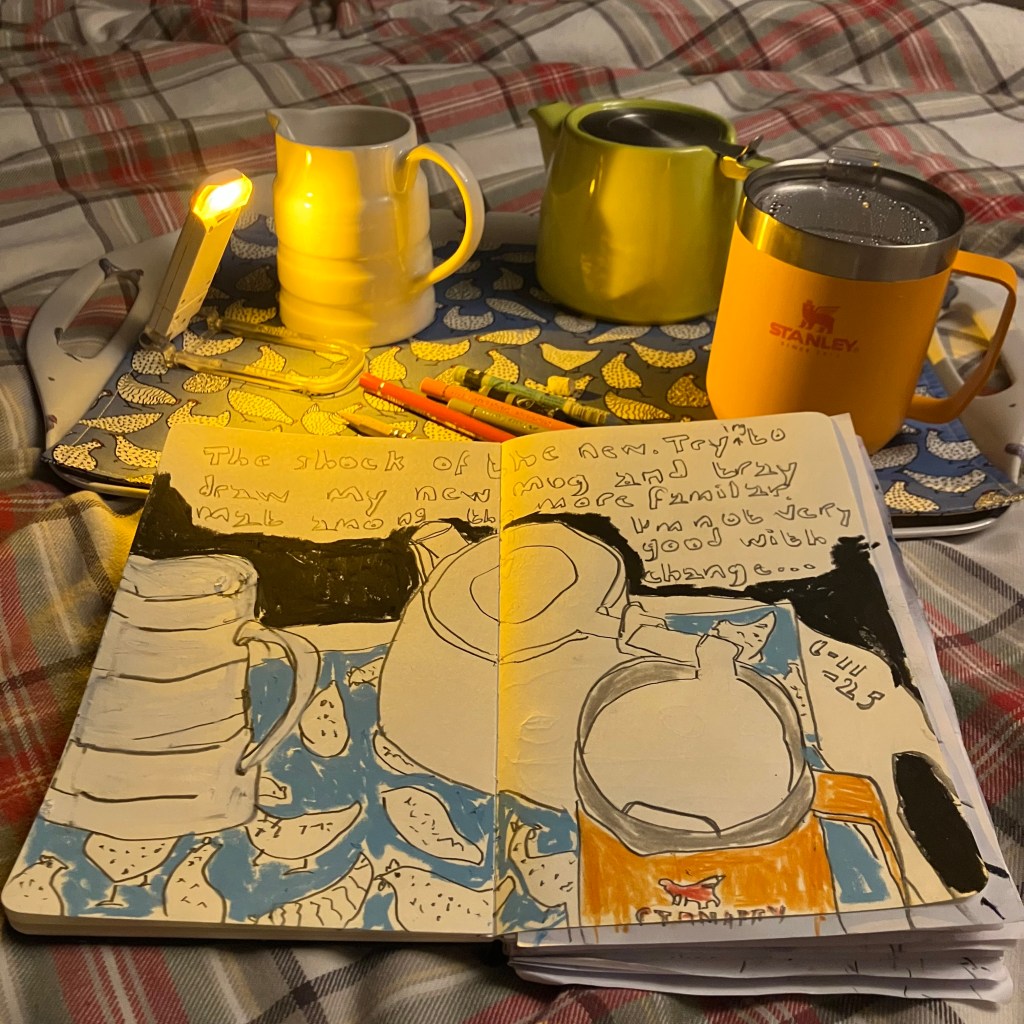
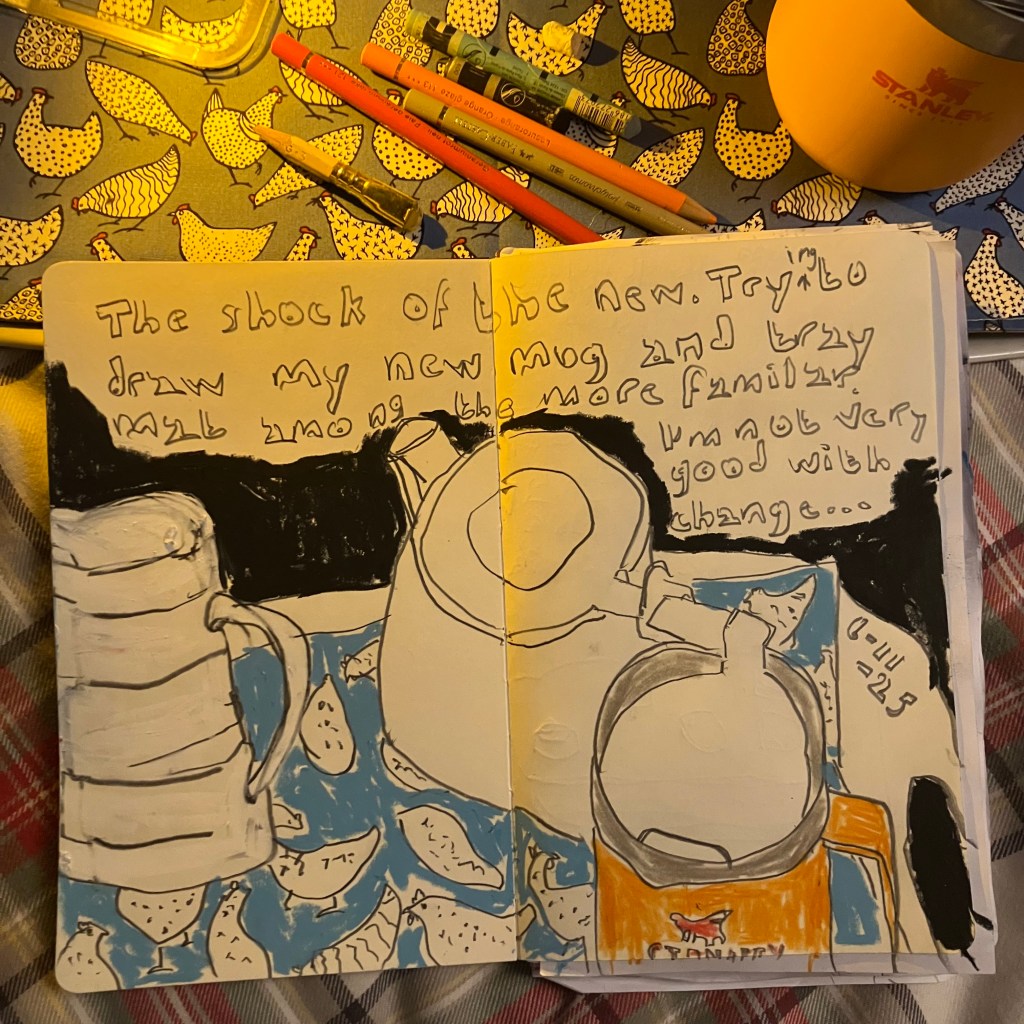
Today’s drawing, The Shock of the New shows the start of a transition. I have a new bright orange mug and a new turquoise tray mat covered with small white chickens. I really love them both, but on my tray, in this drawing, they both felt out of place — loud, jarring and too new.
Drawing through the discomfort of transition
In the drawing, the new mug appears only partly on the page, as though it hasn’t quite entered the familiar world of the drawing yet. The chickens on the tray are clumsy — my hand doesn’t know their shapes, so it feels its way slowly, uncertainly. Nothing is fully settled. I am still working out how these new things belong.
As I stayed with the drawing, I noticed that something began to shift a little. The new objects didn’t feel comfortable, exactly — but they felt less abrupt. I wasn’t trying to make them fit, but I was enjoying exploring them and and feeling the possibility that they might.
What I’m beginning to understand
I’m beginning to see that drawing helps me move slowly through a change, to sit with the discomfort of it, and to let something unfamiliar become part of my world. In that sense, it is a therapeutic process.
More than that, I’ve realised today (with a quiet shock of recognition) that my recent drawings have also been revealing a little more about me than I had quite seen before. I think that understanding is part of another transition and I need to let it arrive slowly too — drawing by drawing.
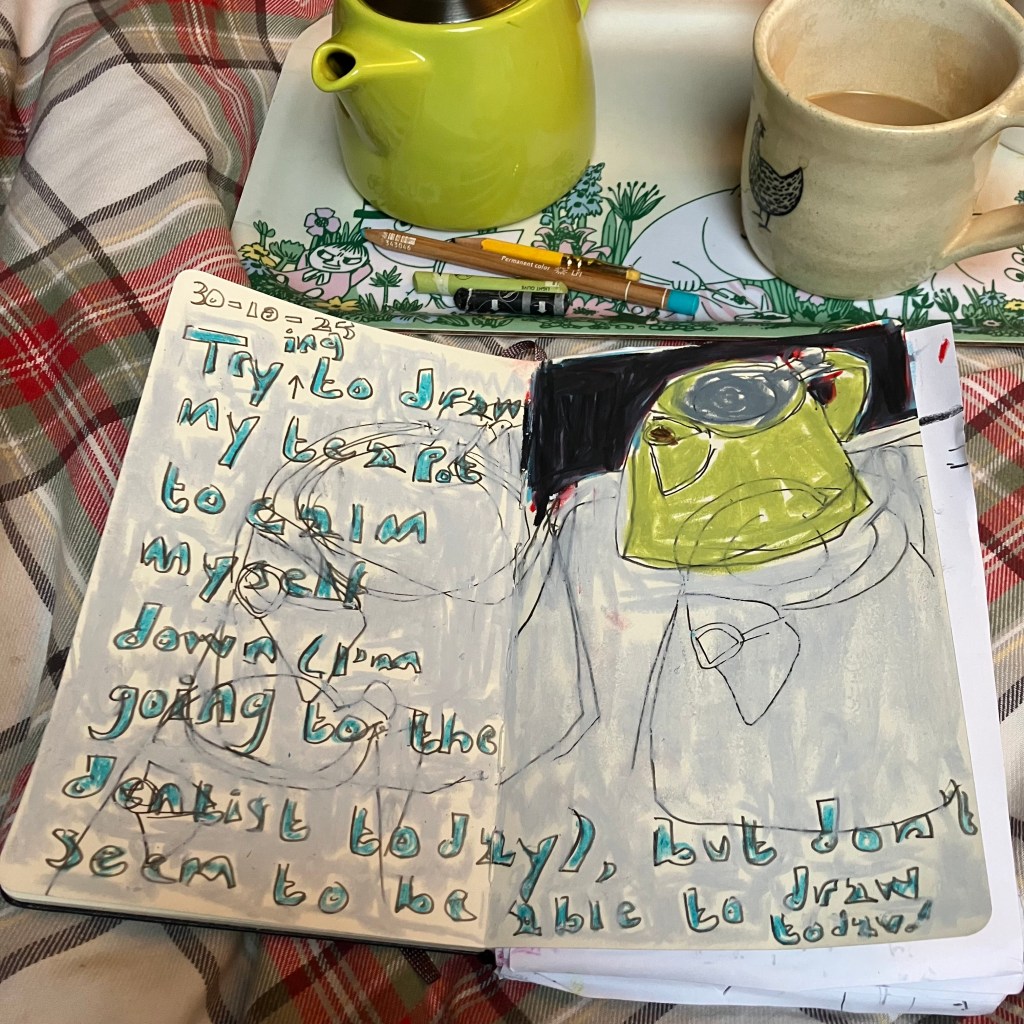
I’d been okay last night, but this morning I woke up feeling very anxious about today’s dental appointment. Early-morning anxiety used to be a regular occurrence when I was first diagnosed with ME, and a more generalised social anxiety has followed me through my life — though I wasn’t always aware of it. I’ve always struggled with going to the dentist.
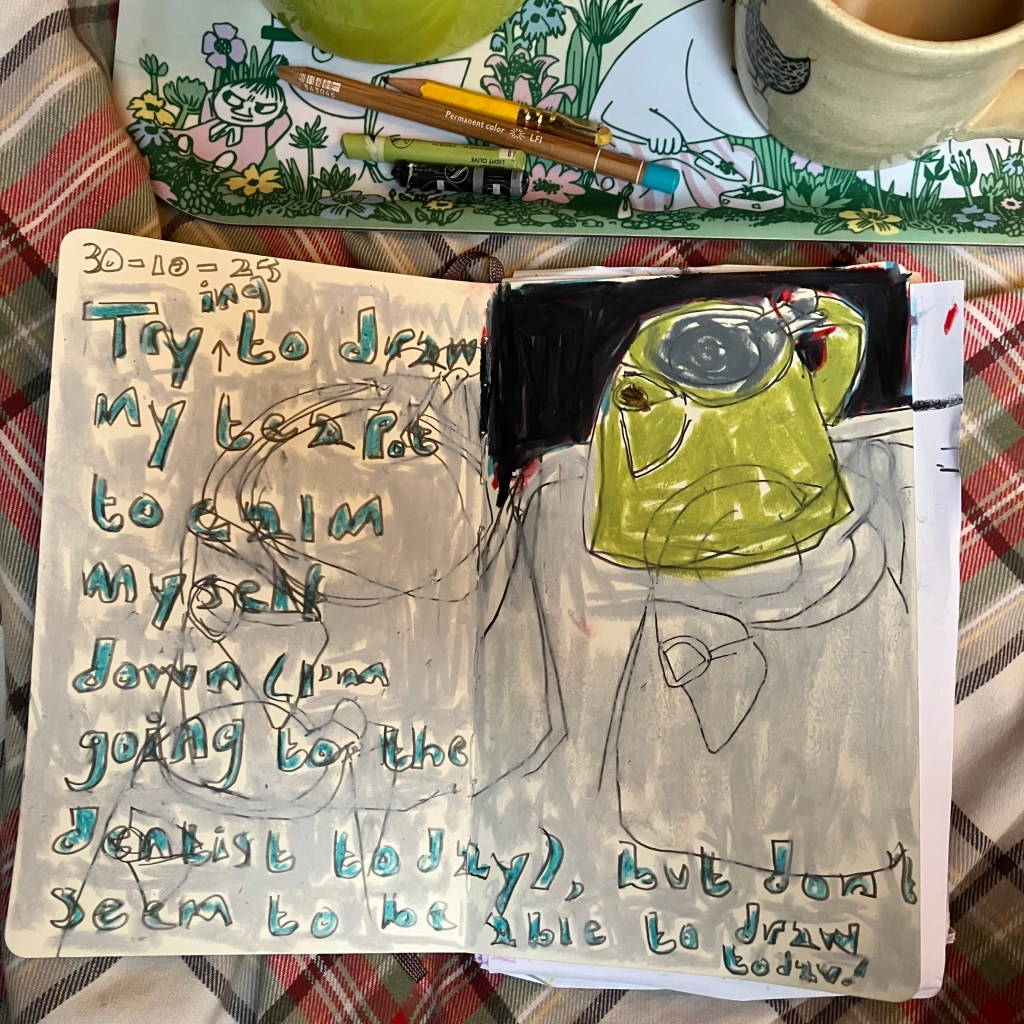
I’d hoped that my current morning routine of making tea followed by making a drawing would help to calm me today, as it did to some extent yesterday. I decided to keep it simple and just draw my teapot — something I’ve done hundreds of times. But today nothing felt right. I tried to draw slowly, beginning with the teapot’s spout, then gradually adding the top of the pot, its handle and hinge.
I’m not someone who worries much about perspective, but I do look for something that feels satisfying — something that works within its own small visual world. After three attempts, filling the page in ways I wouldn’t normally do, I found I was adding drawing anxiety to my dental anxiety. I drew one more version of the teapot and decided that it would have to do, no matter how it turned out.
I added some colour to distinguish it from the earlier attempts, then layered a heavy scribble of Silver Grey Neocolor II over the top to partly obscure them. At that point I began to enjoy myself, and the drawing anxiety (if not the dental) began to recede. There’s something satisfying about those semi-hidden lines under the grey — a quiet record of my anxious searching for calm.
Home now from my appointment and resting on the bed with a second pot of tea, the dental anxiety has passed. Perhaps it was an anxiety that no amount of drawing could dampen. But drawing could record it — and distract me for a while — and maybe that’s enough.
The full text reads:
Trying to draw my teapot to calm myself down (I’m going to the dentist today!), but I don’t seem to be able to draw today!