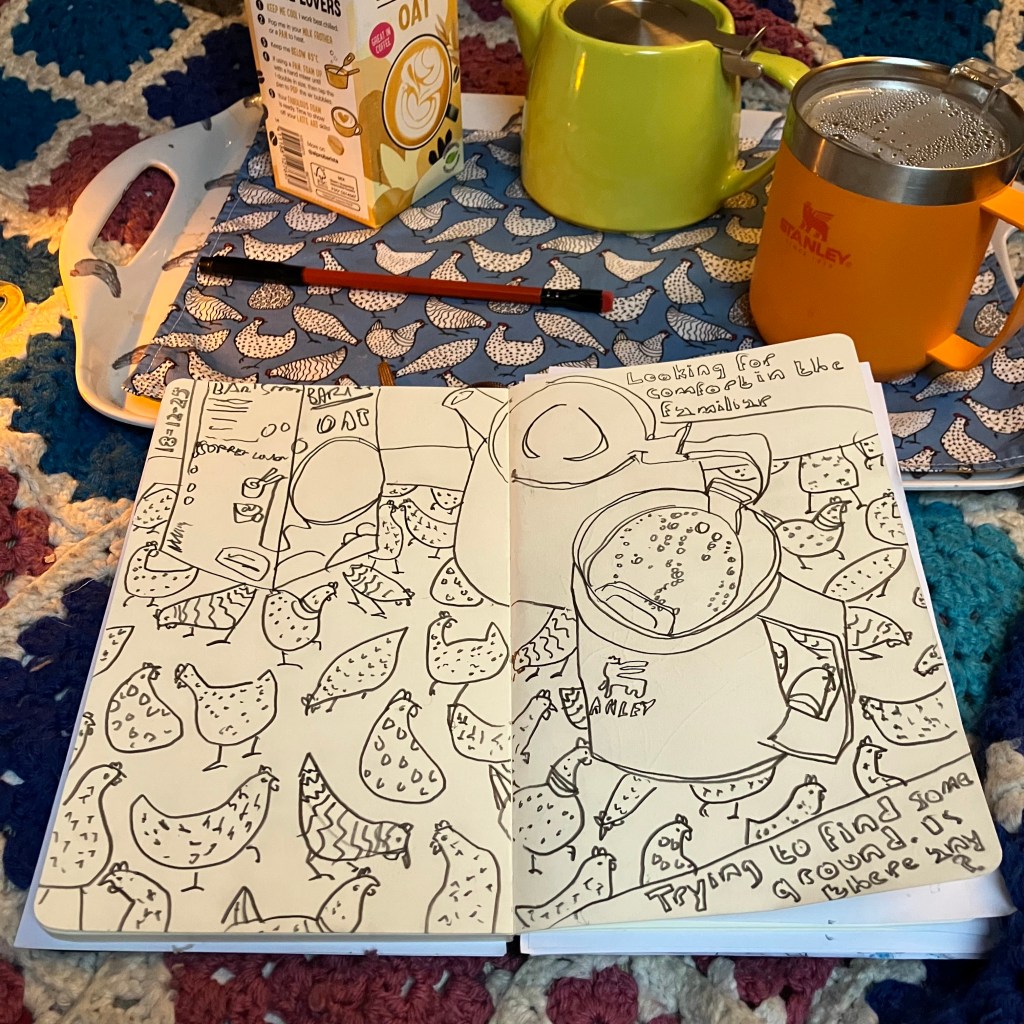
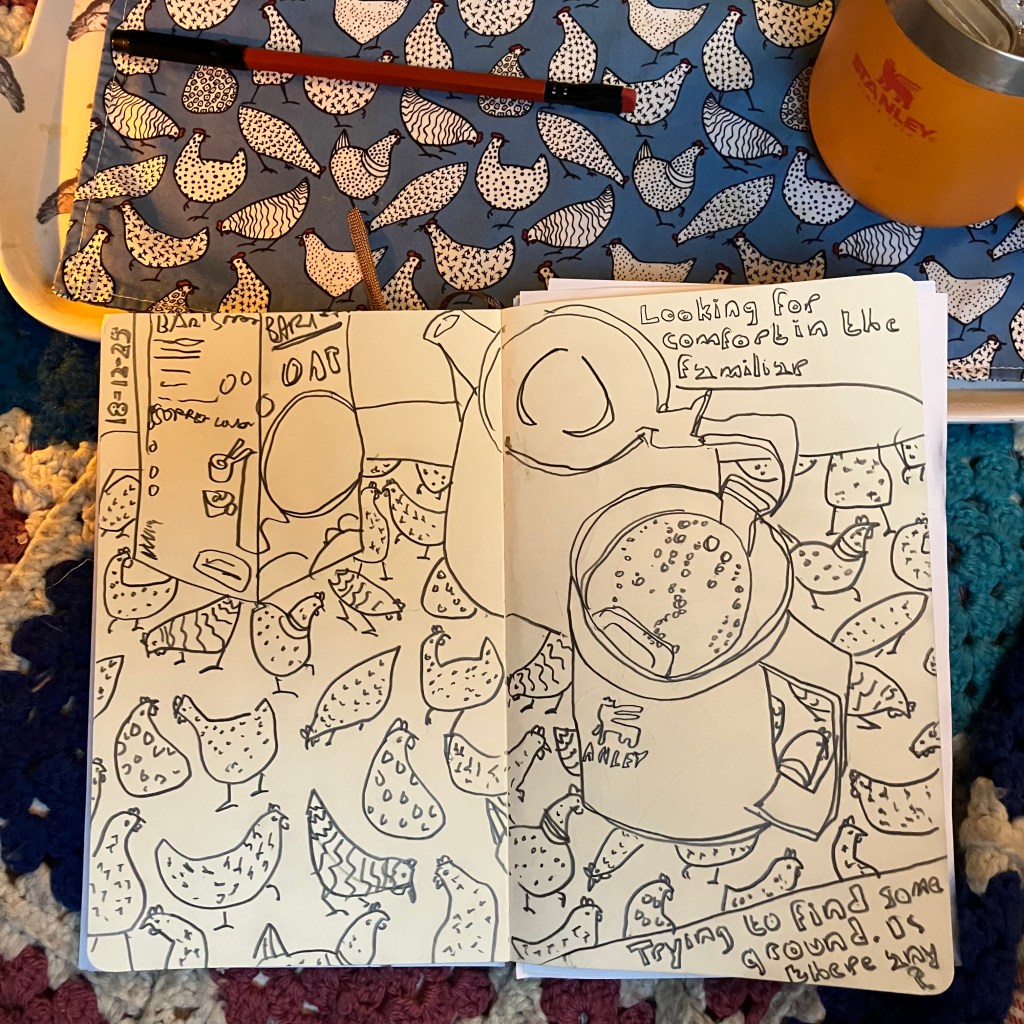
I made a drawing this morning hoping for a little comfort. I drew the objects I know: mug, teapot, oat milk, tray. Familiar companions to steady anxious hands.
As I worked, I found myself thinking about “firm ground” — the feeling of being steadied by something reliable. I’d hoped the drawing might give me that today. But as the lines unfolded, I realised that hunting for ground might be what pulls me off balance in the first place.
Maybe there isn’t firm ground in the way I keep wanting it. Maybe drawing is simply a way of staying with that uncertainty for a few minutes at a time — accepting the unsteady surface, line by line, rather than trying to find something solid underneath.
A note to self: perhaps comfort can come from letting go of the search.
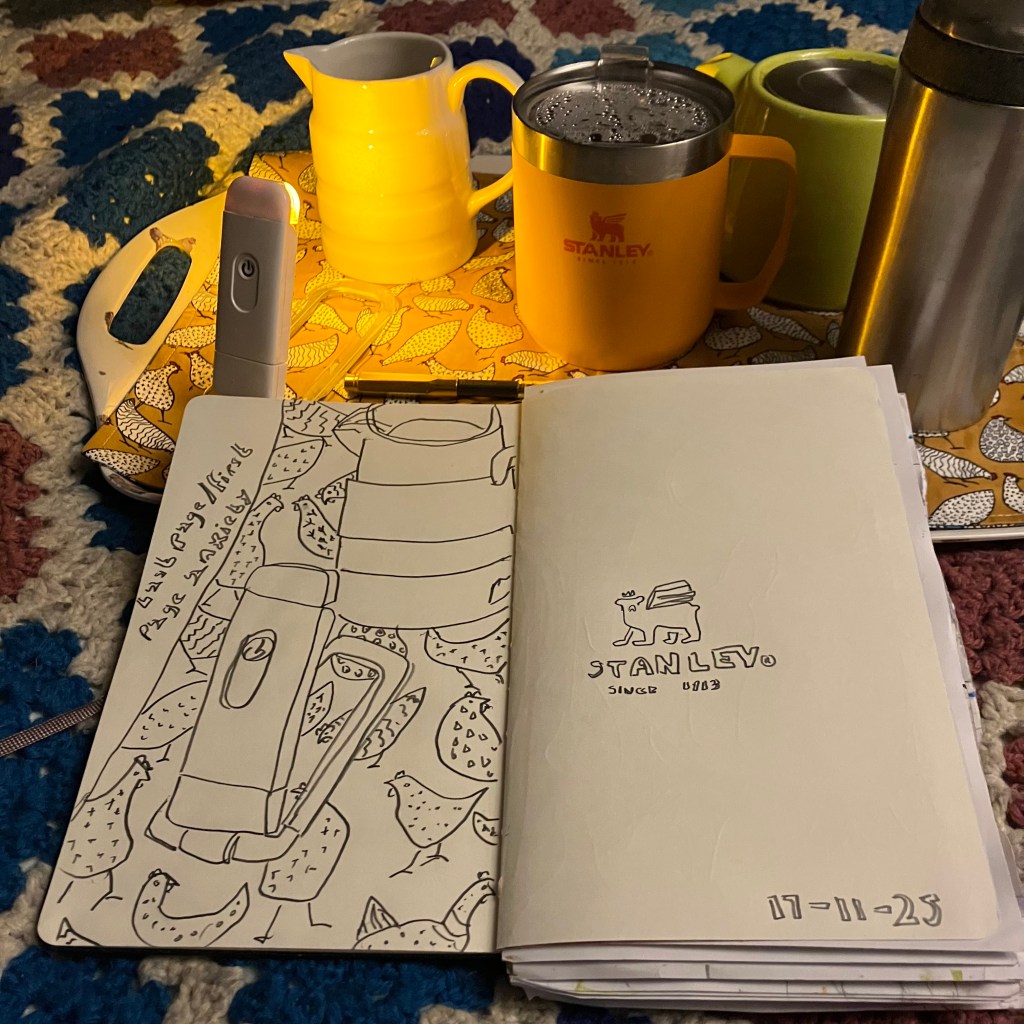
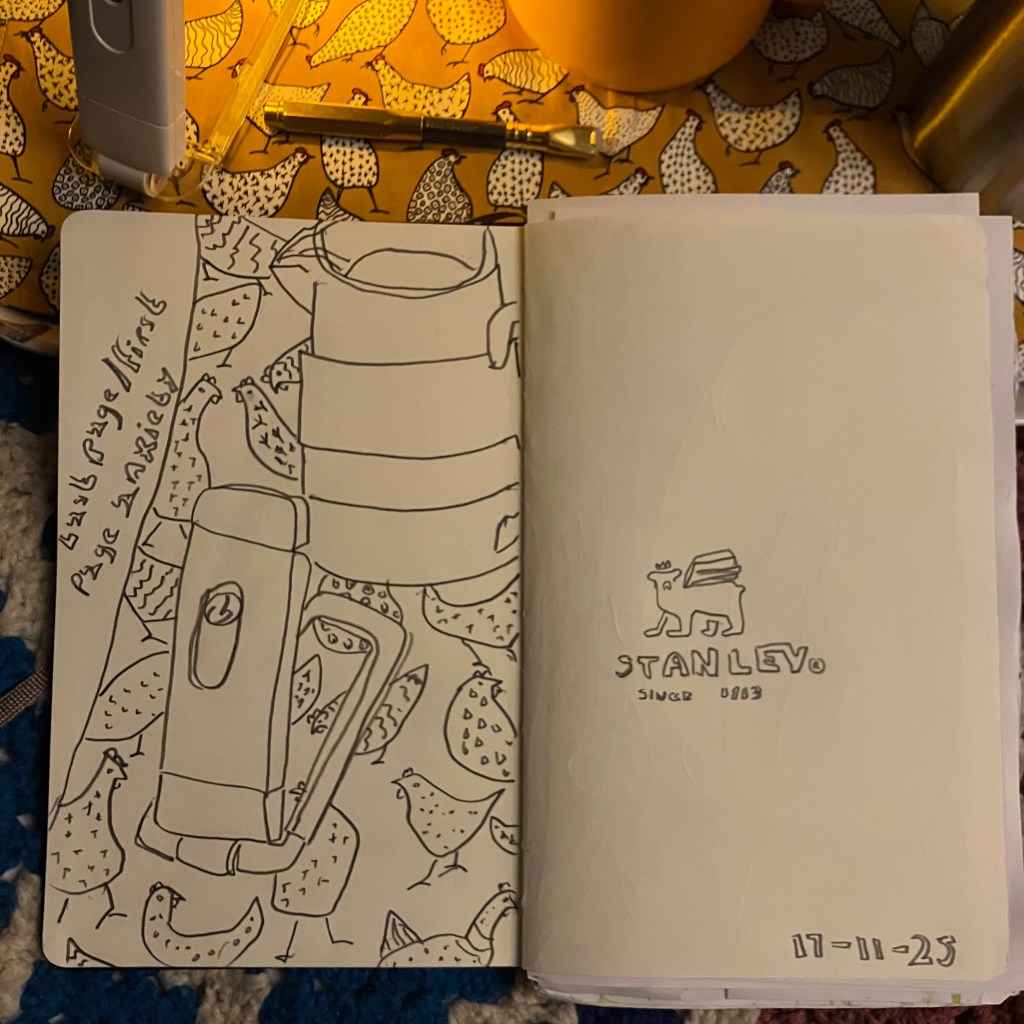
This morning I woke with a tightness around the idea of making my morning drawing — a physical resistance to picking up my sketchbook. I’ve been working backwards through this sketchbook, so although I’d reached what was, for me, the final blank spread, it was also the first pair of pages after opening the cover. I’d been feeling it coming for days and, unusually, it had been haunting me.
I’ve been working this way through sketchbooks for more than two and a half years — since I first returned to drawing after Mary Gordon died. It was a strategy born out of needing to avoid the paralysing pressure of a perfect first page. At first I simply chose random places to draw, but soon I settled into working from back to front. It has served me well, but with this sketchbook that first-page paralysis has reared its head again — maybe because of the recent stress around my health and all the newness.
Interestingly, in worrying about meeting this page, I’d forgotten about the power of routine. Simply making my tea, arranging my tea-things on the tray, and bringing it back to bed found me reaching for my sketchbook and pencil and beginning to draw. I stayed gentle and started with something small and contained: the Stanley logo on my insulated mug. I’ve been wanting to draw it for a while, and its sparseness felt like the right entry point. Once that was on the page, the drawing grew easily — the reading light, the illustrated hen mat, the milk jug. Familiar shapes. Familiar company.
I decided not to add any colour, and as I dated the drawing to mark it as finished, I felt a quiet satisfaction at having made it through that moment of resistance — and at having filled another sketchbook, one drawing at a time, from back to front.
Lately, I’ve been thinking about the drawings that make me uncomfortable, embarrass me — the ones I’d like to rip out of my sketchbook and forget.
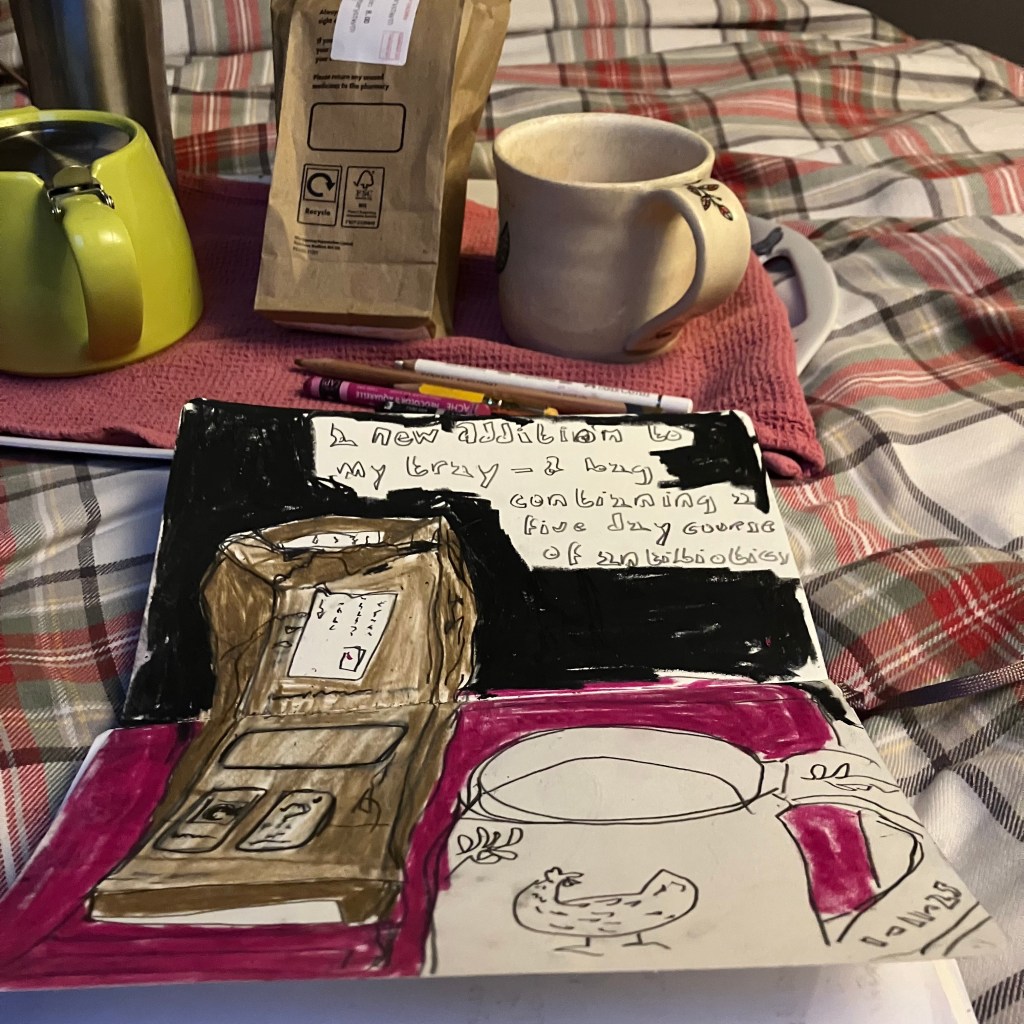
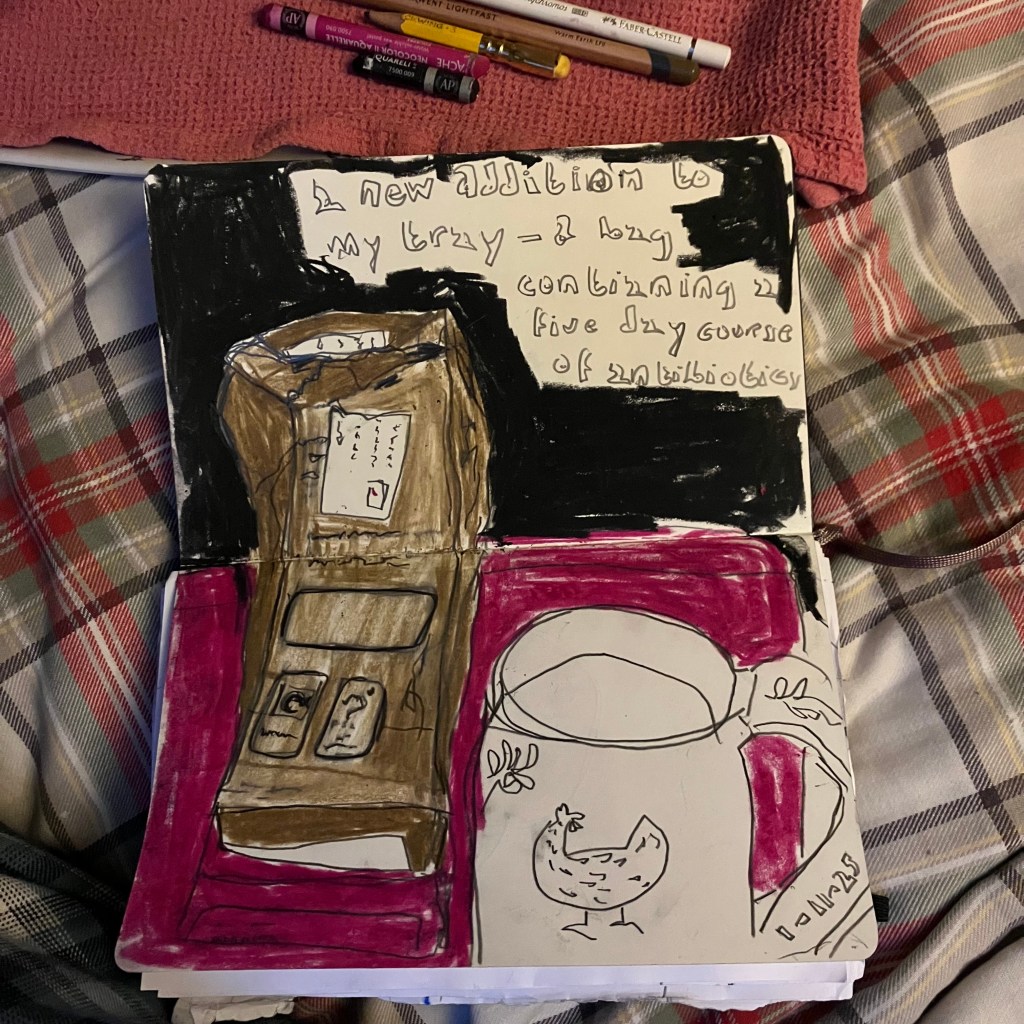
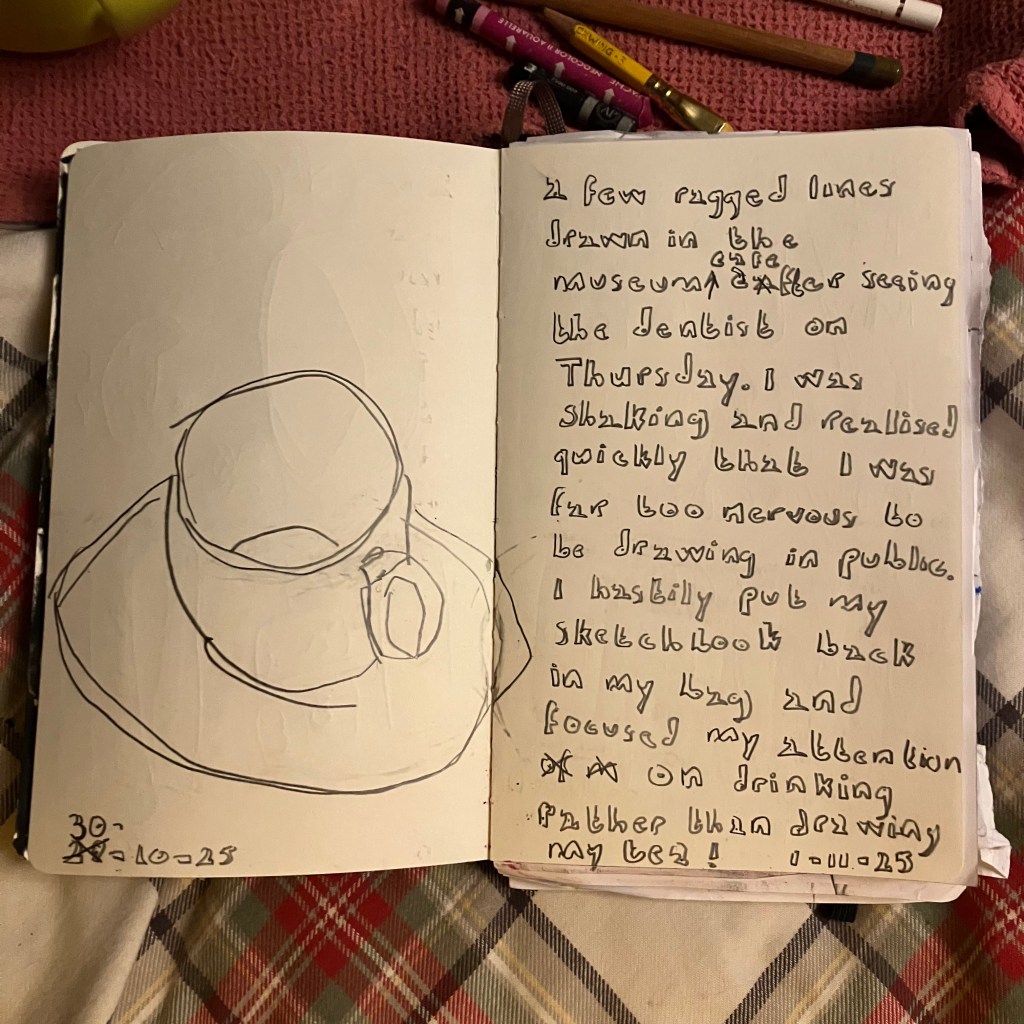
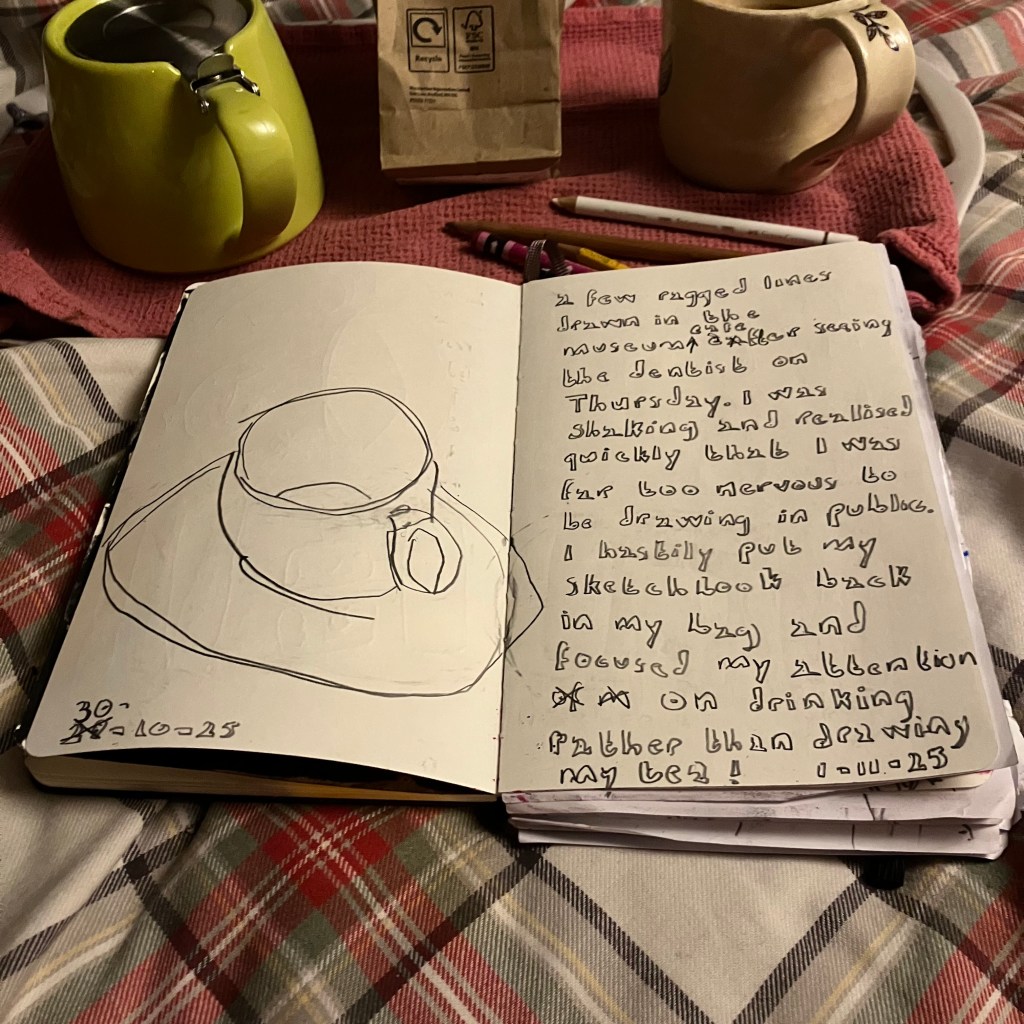
This week there have been two of them (so far!): A Few Ragged Lines, drawn in the museum café just after my dental appointment, and A New Addition to My Tray, made from bed this morning.
In the café, I managed only a few hesitant marks before realising how shaky I was. The drawing stopped almost as soon as it began. Today, a few days later, I added the text and then began A New Addition to My Tray — my first attempt at drawing since that trip to the dentist. I realised quickly that I was still dealing with anxiety. The text on A Few Ragged Lines is ragged and uncertain — I corrected myself more than once — and in A New Addition to My Tray I kept reworking the small brown pharmacy bag. The more I drew, the more uneasy I felt.
On embarrassment and honesty
There’s a particular kind of embarrassment that comes with this — when a drawing feels raw, clumsy, too revealing. Some of that embarrassment is about what the drawing might expose, but more immediately it’s about how it looks: awkward, unresolved, unskilled. It’s the discomfort of seeing something I’ve made that doesn’t live up to how I wanted it to be. For a while I often can’t bear to open my sketchbook and look at what I’ve made.
After a few days (sometimes hours), those feelings can shift. With A Few Ragged Lines, that has happened — I have begun to see the original lines that I made on Thursday, not as failures, but as traces of persistence, an honest snapshot of a difficult moment in my life. The trembling, the awkwardness, the unresolved forms: they all speak of the effort to keep going, even when calm attention won’t quite come. Maybe, in time, I’ll be able to see today’s drawing in a similar light…
Preserving the work as it is
Part of my practice now is to preserve and reveal my sketchbooks exactly as they are. Once I add the date to a drawing, it’s finished — a small record of that moment, however incomplete or uneasy it feels. I want to resist the temptation to tidy, edit, or hide these pages. I want them to remain a true reflection of the moment that they were made, however that feels and whatever they reveal.
I’ve been thinking about whether adding text to A Few Ragged Lines days later sits outside my usual way of working. Because the text was written on the opposite page and dated separately, it still feels fitting somehow. Perhaps it simply reflects how the drawing continued to work on me for a few days before I could meet it again. It’s something to keep in mind for future pages.
The practice of staying
Embarrassment, I realise, is often just the shock of honesty — the moment when a drawing shows something we didn’t mean to reveal, whether that’s in its awkward form or in the feelings it carries. It’s uncomfortable, but it’s also what makes the work alive. Those uneven marks and half-resolved shapes tell the truth of how things were: the body still unsettled, the hand trying to steady itself, the mind circling back to breath.
I’m realising that these uneasy drawings belong to the practice just as much as the easy ones do. Maybe they are the practice — the record of staying with myself, however briefly, in a moment I’d rather have avoided.
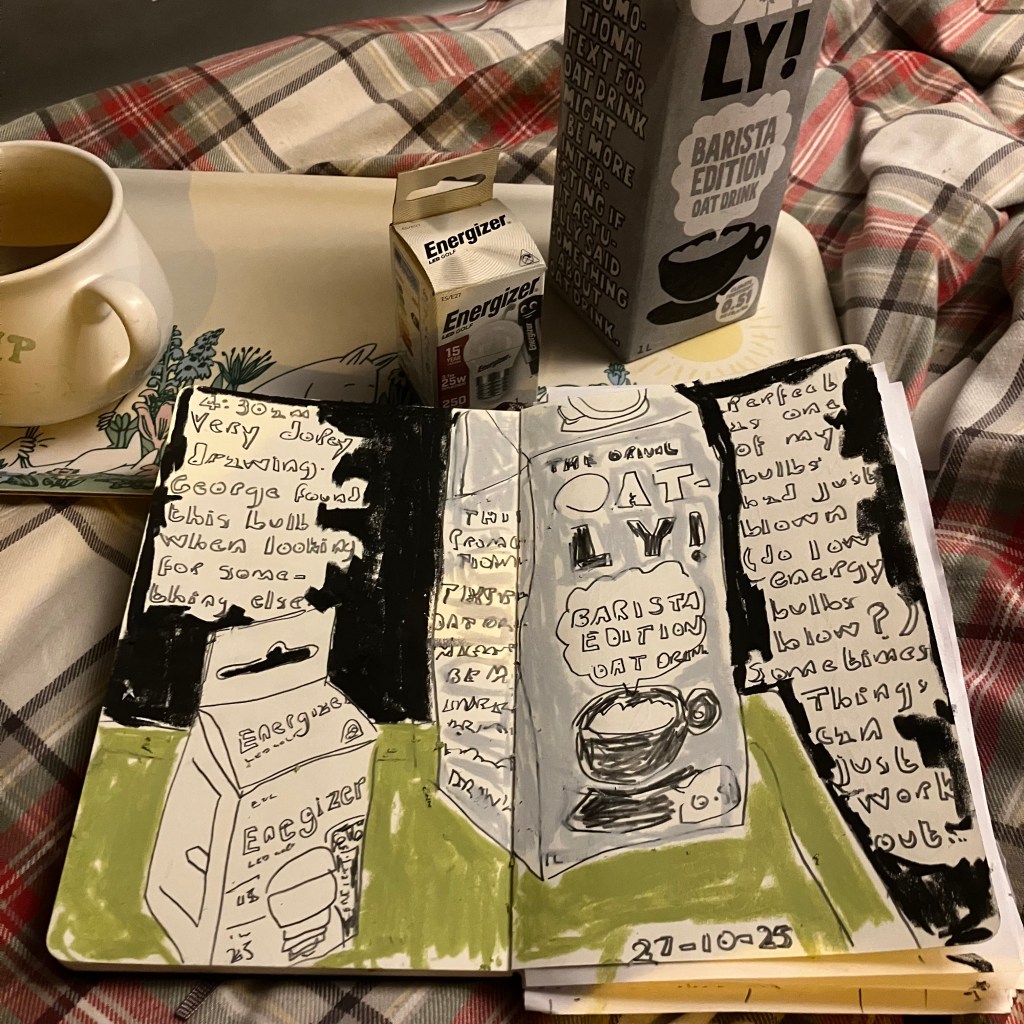
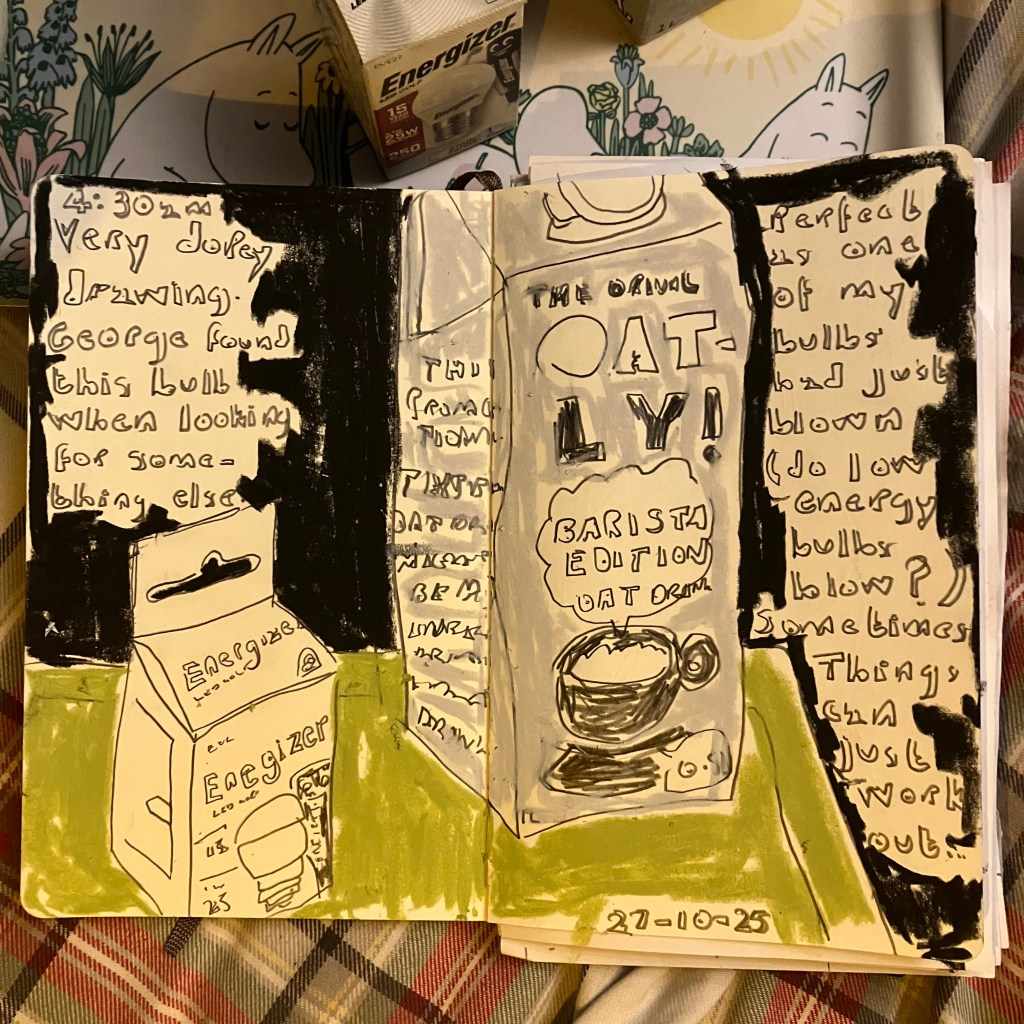
Today’s Tea-Tray drawing, made at 4:30 a.m. when I couldn’t sleep.
An Oatly Barista carton, an Energizer light bulb box, and my Onion Soup mug were all on the tea tray, though the mug didn’t find its way into the drawing.
G. had just found the bulb while looking for something else, moments after one of the lights blew — a small thing, but it felt like a sign that maybe not everything has to be difficult. I was about to put the bulb box into the recycling and then decided I could draw it instead. A tiny decision, but one that changed today’s drawing from my more usual composition. (I’m going to put the bulb box into my physical Ephemera archive.)
It was drawn with my Blackwing 3 pencil and two Neocolor II crayons (black and light olive). I felt very dopey and suspected I wasn’t equal to the task, but I’m glad I persevered — so that now this drawing exists as a tiny record of a quiet moment of domestic calm, and the small satisfaction of things unexpectedly working out.
The full text reads:
4:30 a.m. Very dopey drawing. G. found this bulb when looking for something else. Perfect as one of my bulbs had just blown (do low-energy bulbs blow?). Sometimes things can just work out.
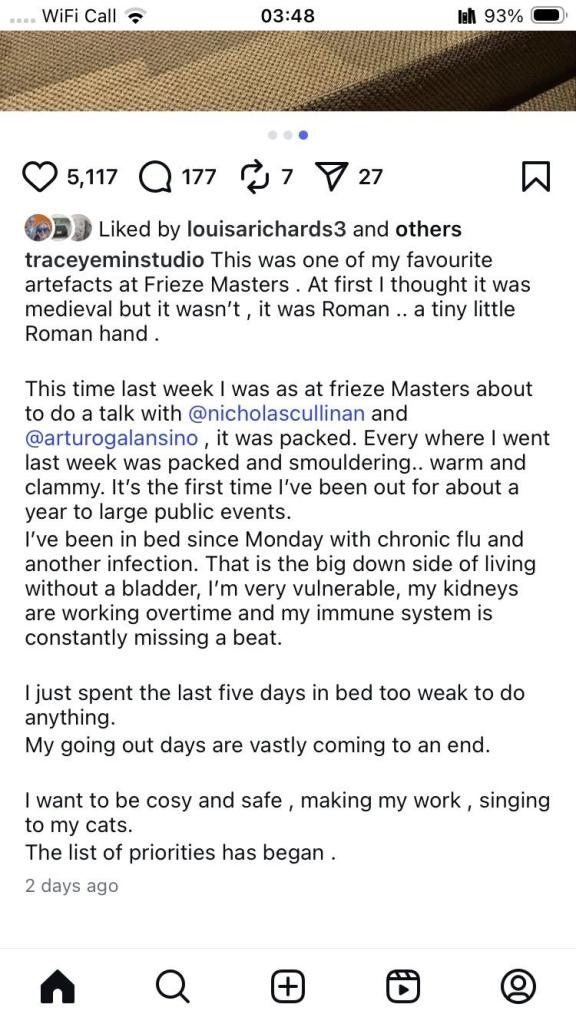
I came across this Instagram post from Tracey Emin in the middle of the night — drinking (decaffeinated) tea, drawing, and quietly scrolling on my phone.
She wrote about the aftermath of Frieze Masters — the exhaustion that followed, days spent in bed with chronic flu and infection, and the sense that her “going out days are vastly coming to an end.”
There’s a raw honesty in her words, and a tenderness too. Reading them in my half-awake, foggy-brained state, I felt an immediate recognition — the pull toward stillness, the need to stay close to what matters, to accept the body’s limits and still keep making.
“I want to be cosy and safe, making my work, singing to my cats. The list of priorities has began.” — Tracey Emin
That line lingers. A reminder that slowing down isn’t necessarily stopping — that work, care, and living can continue quietly, within smaller boundaries. Sometimes the most enduring persistence is simply remaining present.